This is Not Your Promised Country
An Ode to St. Brendan the Voyager
“Where can wisdom be found? And where is the place of understanding? Man does not know its value, nor is it found in the land of the living.” - the Book of Job
Long before we had our first boy, my wife and I knew we would name our first son Brendan. It was one of the easiest decisions that we’ve ever made. The reason we were so perfectly set on it is that St. Brendan of Clonfert, called the Navigator or the Voyager, was the Christian hero from afore-times most dear to both of our hearts.
St. Brendan was born on the western coast of Ireland in the year 484, at the beginning of what is typically labeled by historians as the “Dark Ages”, but which was truly the Golden Age of the Irish saints, as the light of the gospel drove out the darkness of pagan idolatry and which was able, to a limited degree, even to thaw the icy hatreds of tribal warfare in that land. St. Brendan’s major contribution was to found dozens of monasteries throughout the British Isles, especially on rocky promontories and remote islands. Clonfert, however, the most famous of his monasteries, was located inland in county Galway and became a center of wisdom and learning for generations to come.
Now those are the main facts, but what is really breathtaking, is the personality or atmosphere of the saint, as he is known in the many stories about him. Speaking of atmosphere, the earliest medieval accounts say that his name comes from the Irish for “white rain”. This etymology may be spurious, but it is quite fitting, since rain evokes the wet and the weather that were Brendan’s constant companions during his famous open-boat voyages, and white calls to mind the bright splendor that sometimes shone from his face after he had spent many hours in prayer, making it impossible to gaze upon, like the face of Moses coming down from Mount Sinai.
On a deeper level, however, the atmosphere that hangs like a fine mist over the legends of St. Brendan is one of absolute trust in God, of wonder at the marvels of this created world, and of deep longing for the world to come. St. Brendan’s thirst for transcendent wisdom was too great ever to be satisfied within the confines of this world. I’ll say more about this at the end, but first I’ll do my best to give you a taste of the man himself by recounting some of the stories about him.
Brendan’s first encounter with water was most likely at his baptism, at the hands of St. Erc the bishop. His first taste of exile was soon to follow. The boy Brendan was but barely weaned when he was taken from his parents by the bishop Erc, and given into the care of the holy virgin Ita of Killeedy, who loved him deeply and raised him to know right from wrong. The child’s innate curiosity was already apparent when he asked his foster mother to tell him what three things are specially loved by God. St. Ita answered that God most loves true faith, simple living, and generous love.
When Brendan reached the age of five, the bishop took him personally in hand and taught him how to read and how to pray. It seems that St. Erc was living in seclusion in the forest for much of this time, for we hear that the wild beasts were held back from harming his young protegee by God’s special protection. It also happened one day that St. Erc ran out of food to give the growing boy, and so he prayed to the Lord, and a deer with her fawn came from a nearby mountain to supply milk for the child.
As a youth, Brendan was sent north to study at the feet of St. Iarlath where he received instruction in the Holy Scriptures and in monastic discipline. Brendan helped him to found a monastery and sooned gained a good reputation in that part of Ireland. Not long after his training there was completed, God used him to raise a boy from the dead by his prayers, which caused many disciples to begin flocking to him. A local king even offered him land to establish a monastery, but Brendan refused. He fled from worldly acclaim and went back to County Kerry, the place of his birth, but his disciples followed him there. Both the virgin Ita and the bishop Erc, along with his parents and other relatives rejoiced at his return, and St. Erc ordained him a priest, but what Brendan really wanted was a solitary life.
Soon after that, something happened to him while he was fasting and praying alone in the mountains. He prayed to God to give him a secret, hidden, and lonely land in which he could spend the rest of his life in silence and prayer. He must have felt what St. Silouan of Mt. Athos felt when he said, “When the soul approaches the Lord she is afraid; but when she sees the Lord, the beauty of his glory fills her with ineffible joy and in the love of God and the sweetness of the Holy Spirit the earth is quite forgot. This is the paradise of the Lord.”
Having climbed a certain mountain that stood near the seashore, St. Brendan looked out from it across the mighty and intolerable ocean. From there his sharp eyes discerned (or was it a supernatural vision?) a beautiful island shining in the distance. It is said that an angel of the Lord came to him then and said, “Arise, O Brendan, for God hath given thee what thou soughtest, even the Land of Promise. And I will go with thee henceforward and for ever and ever, and I will teach thee to find the blessed isle thou hast seen.”
So Brendan fitted out a boat with a wooden frame covered by thick animal skins and having a single sail. Then he and fourteen monks hand-picked from among his followers,
set sail upon the great, cold ocean. They took no provisions with them, but trusted God to take care of all their needs. Wherever the wind blew them and the waves tossed them, that was where they went. Whatever fish they caught, that was what they ate. Many were the strange creatures they encountered. Many were the islands they visited, both deserted and inhabited, and many were the deadly perils they escaped from. In all things they trusted in God to deliver them.
Listen to what Brendan said to his followers during moments of extreme danger:
When the wind deserted them, he said: “Brothers, do not wear yourselves out with labors, for the Lord is our helper and the pilot of our boat. Stow your oars! Only give full sail, and may the Lord do what he will with his servants and our boat. Fear the Lord, for he is well pleased by those who fear him.”
When two ferocious seabeasts were coming at them from both sides, he said: “Do not be frightened, O you of little faith. Did not Apostle Peter walk upon the waves for as long as he did not doubt? But as soon as he wavered in his faith, he began to sink. Therefore God, who is our defender forever, will himself deliver us from the jaws of this beast…[and] from all the perils of the sea…Look my sons! Witness the great deeds of God almighty, and see the obedience which a creature now shows to its creator. Wait a little, dear ones, and see how this thing ends, for this beast fights on our behalf against that one, and it will do us no harm.”
And at another time when all the sea all about them was teaming with unknown creatures of diverse kinds, so that the other monks begged the saint to pray more quietly lest his voice should attract the attention of a hungry fish, he replied: “I marvel at your foolishness, that you should fear now these creatures. Is not our God Jesus Christ the Lord of all things? And is He not able to tame every kind of beast?” Having said this, he immediately began to celebrate the Holy Eucharist there in the boat, lifting his voice in loud song over the waters, and at the sound of his voice, the multitude of creatures grew to such a throng that the sea itself could hardly be seen, and they swam in concentric circles around the boat as though in reverent worship of the body and blood of their Creator.
And so God not only protected them, but he revealed to them some of the hidden mysteries of the cosmos. It is said that their voyage took them nigh to the very gates of hell where they could hear the blowing of the bellows and the howling of the demons and could smell the sulfur and the burning. Their voyage took them also to a secret chapel suspended on a pillar of crystal. The pillar rose vertically from the umplumbed depths of the abyss and reached to the unmeasured heights of heaven. At every opportunity Brendan asked questions of those he met, and much like the Apostle John in the book of Revelation he received mysterious answers.
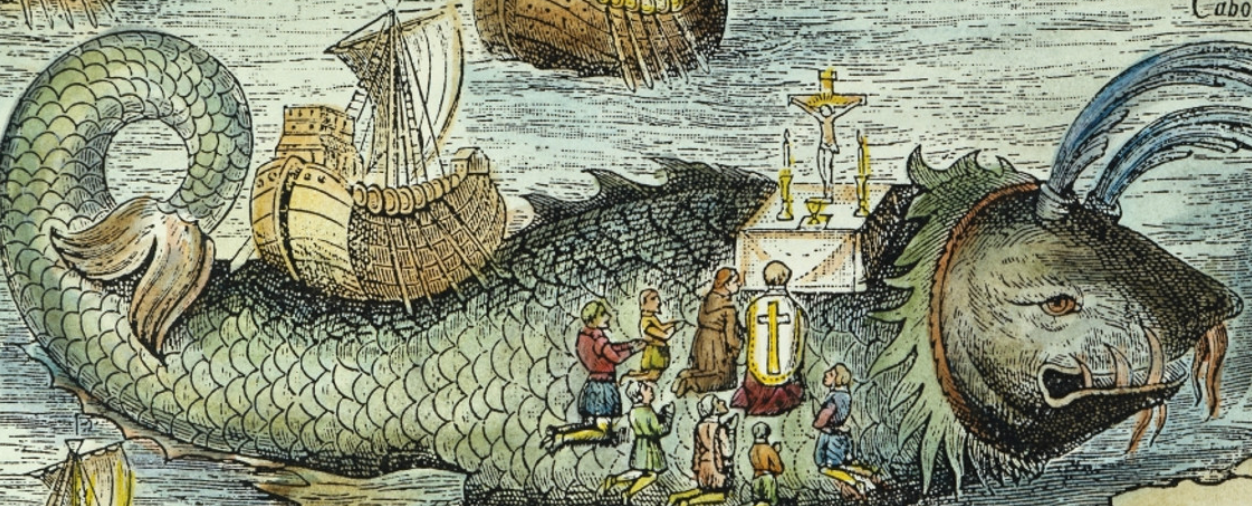
God not only showed them wonders such as these, but also used them to demonstrate the truth of Our Lord’s claim, Who said, “All authority in heaven and on earth has been given unto Me.” For indeed, not only were the beasts of the sea powerless to hurt them, but even the principalities and powers were subject to them. On Holy Saturday, for instance Brendan and his monks celebrated the Easter vigil on the back of Leviathan. The next day they struck aground on a rock island where stood a single tree of enormous size, whose branches were covered with white seabirds – or rather they appeared to be birds, but they were singing psalms with angelic voices, sweet but sad. Brendan prayed to God to untie this knot for him. God found his prayer acceptable, for one of the white birds flew down to him and explained that they were a choir of half-unfaithful angels who had not joined fully in Lucifer’s rebellion, but were nonetheless doomed to wander the earth in penance, and yet by God’s mercy were allowed to congregate on this island every Lord’s Day to sing the God’s praises.
Brendan and his companions wandered upon the sea for five years. At the end of that time, they came upon a lofty island, surrounded by inaccessible cliffs. They could see a church high above them, and they could hear a choir of human voices singing psalms and hymns to God, but though they searched for several days, they could find no place on which to land their boat and come ashore. Finally a wooden tablet was let down on a rope from the mountain above. There was a message carved in it which said, “This is not your promised country. You will come to it at last, but this is not it. In the meantime, go back home to Ireland, for your own people need you badly.” Brendan obeyed the message and set sail for home. Can you imagine his disappointment?
When he arrived back in Ireland and told the story of his travels, the faith of the faithful was strengthened, the hearts of unbelievers were turned to God, many sinners repented, and some even gave up their worldly possessions and dedicated themselves to a life of prayer. Then he went to visit his beloved foster-mother. St. Ita welcomed him with joy and said, “Dear one, why did you undertake such a voyage without asking my advice first? Of course you cannot reach the Isle of the Blessed borne on the skins of dead beasts. I might have told you as much.”
Now there are other accounts that differ from this one. The most famous one says that after a voyage of seven years, Brendan did indeed reach the Promised Land of the Saints. But even in that account, there is a point beyond which he was not allowed to go. In that version he was permitted in his mortal flesh finally to reach and to set foot upon the shores of Paradise, the land that knows no night because Christ is its light. But then, after forty days’ journey inland, he came upon a wide river, where an angel appeared and commanded him not to cross, but to go back, for he still had much to do in Ireland and elsewhere before his life’s work was done.
By all accounts, he certainly returned home, and he soon set to work starting missions in unreached corners of Britain and Ireland and establishing monastic houses for his followers in sundry lands. More than once he stood before kings to intercede on behalf of their enemies or to save criminals who were condemned to death. (On one such occasion, he saved the future St. Columba of Iona from execution.) For a man who so yearned for a life of seclusion and contemplation, alone with God and the elements, it must have been hard indeed to be thus engaged in such ceaseless activity. He seems to have served God tirelessly in this way until the day of this death.
So what does all this mean? What exactly was this island that St. Brendan longed for? And if the desire was from God – which he never for a moment doubted – then why did he receive little more than a glimpse of it?
To shed light on this question, I will turn to two different but overlapping ideas that have captured my imagination in much the same way that the tale of St. Brendan’s has.
The first of these is a Welsh concept, not Irish, but there was indeed much traffic and exchange of ideas between Ireland and Wales in St. Brendan’s day. Fr. Gabriel Rochelle describes it beautifully in his book A Staff for the Pilgrim:
The Welsh language has one of those wonderful words we sometimes stumble across that seem untranslatable because of their depth and breadth of meaning. The word is hiraeth, pronounced here-eyeth. If you look in your nearby Welsh dictionary it will tell you the word means “longing, nostalgia.” No other language has a word quite like it, for hiraeth seems to be a deeply Welsh emotion. It is a combination of two words that together mean, literally, long field. Imagine we are on the prairies of Kansas or Saskatchewan, where the fields stretch forever, making it hard to cross to what we want on the other side. That is the inner feeling of hiraeth. Hiraeth is longing for an unattainable end. The horizon keeps receding as we think we are getting close.
Hiraeth is more than just longing, however: friend Robert Jones says “It’s a combination of longing, nostalgia, almost an obsession for a thing, a place, a person or state of being that you may have had in the past or dream about having in the future. You cannot have it, at least not right now, and you may never have it or attain it.” Welsh people have felt hiraeth when they migrate to other places, but of course one can feel it at home in Wales as well. Maybe it is a peculiarly Celtic quality of soul. I have been among Irish folks who show a similar feeling. That feeling resonates through Celtic music with its haunting plaintive melodies, often in minor key.
I must believe that St. Brendan was no stranger to such a feeling. His was surely a powerful and God-given
hiraeth. His story should inspire us to fix our longings on a higher and holier horizon than we are apt to do.
Secondly, I wonder if St. Brendan’s experience was of the kind that C. S. Lewis struggled so heroically to describe in Surprised by Joy:
As I stood beside a flowering currant bush on a summer day there suddenly arose in me without warning, and as if from a depth not of years but of centuries, the memory of that earlier morning at the Old House when my brother had brought his toy garden into the nursery. It is difficult to find words strong enough for the sensation which came over me; Milton’s “enormous bliss” of Eden (giving the full, ancient meaning to “enormous”) comes somewhere near it. It was a sensation, of course, of desire; but desire for what? Not, certainly, for a biscuit tin filled with moss, nor even (though that came into it) for my own past. …before I knew what I desired, the desire itself was gone, the whole glimpse withdrawn, the world turned commonplace again, or only stirred by a longing for the longing that had just ceased. It had taken only a moment of time; and in a certain sense everything else that had ever happened to me was insignificant in comparison.
…[I had experienced] an unsatisfied desire which is itself more desirable than any other satisfaction. I call it Joy, which is here a technical term and must be sharply distinguished both from Happiness and from Pleasure. Joy (in my sense) has indeed one characteristic, and one only, in common with them: the fact that anyone who has experienced it will want it again. Apart from that, and considered only in ist quality, it might almost equally well be called a particular kind of unhappiness or grief. But then it is a kind we want. I doubt whether anyone who has tasted it would ever, if both were in his power, exchange it for all the pleasures in the world. But then Joy is never in our power and pleasure often is.
Lewis believed that such rare and momentary experiences are sent to us by God as means to dislodge us from our petty pursuits and draw our gaze outward to eternity. I suspect that his account of heartbreaking joy (or desirable grief) would have deeply resonated with St. Brendan.
Now, it remains to be asked, what would Brendan have said for himself? What terms might he have used to make sense of it all? Doubtless he would have used the words of the Scriptures in which he was steeped from a child, perhaps such words as these from the Book of Hebrews:
These all died in faith, not having received the promises, but having seen them afar off, and were persuaded of them, and embraced them, and confessed that they were strangers and pilgrims on the earth. For they that say such things declare plainly that they seek a country. And truly, if they had been mindful of that country from whence they came out, they might have had opportunity to have returned. But now they desire a better country, that is, an heavenly: wherefore God is not ashamed to be called their God: for he hath prepared for them a city.
…For here we do not have an enduring city, but we are looking for the city that is to come.
I would argue that what in St. Brendan’s story appears to have been a journey outward into the unknown was really an inward journey, a homeward journey. And I believe that Brendan himself must have thought of it that way. For it was a journey toward his true home, the one which Christ has won for all of us by His dying and rising from the dead. As the Eastern Orthodox sing at Pascha, the celebration of Christ’s resurrection, “A Sacred Pascha hath been shown forth to us today…a Pascha that hath opened unto us the gates of Paradise.”
In the end, the voyage that began with Brendan’s baptism was completed with his death. An old friend of his, St. Columba, is said to have seen a vision on the day that Brendan died. Columba witnessed his friend being conducted by angels through the gates of paradise at last.
I love St. Brendan because he combined the uncompromising faith of the prophets with the innocent audacity of a child. Because he was equally a man of contemplation and of action. And because he set an example for us of holy longing that cannot be satisfied by anything less than the pearl of great price, the kingdom of heaven.
I will close with a quote from C.S. Lewis’s Letters to Children. This is from a letter he wrote to a class of fifth graders in response to their questions about the Voyage of the Dawn Treader, a book obviously inspired partly by the story of St. Brendan:
[A]nyone in our world who devotes his whole life to seeking Heaven will be like [Reepicheep]...Yes, Reepicheep did get to Aslan’s country…The only way for us to [get to] Aslan’s country is through death, as far as I know: perhaps some very good people get just a tiny glimpse before then.
Share this Post on Your Preferred Platform