The Hall of Men: A Local Fellowship Hall Where the Men Break Bread, Tap the Keg, & Toast Their Heroes

by Barry Owens
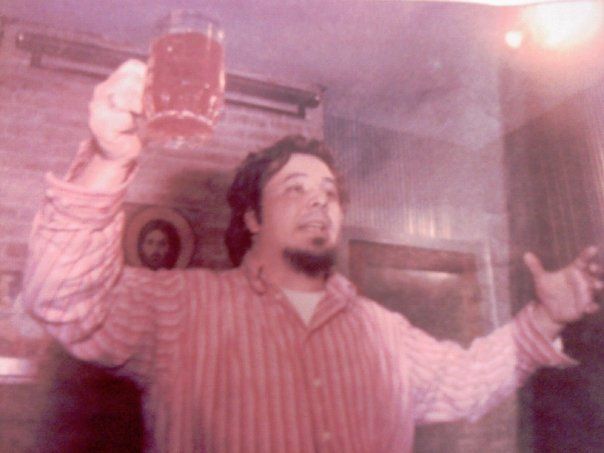
THE MEETING is about to come to order here at the Hall of Men, where heroism is celebrated and masculinity is encouraged. The men, seated at an oak table that nearly fills the room, push away their soup bowls.


“Gentlemen,” says George Elder, raising his glass at the head of the table.


He offers a toast, drawn from a tale from the Battle of Maldor, where the Vikings overran the English at Essex in 991 A.D. During the battle a swordsman stood to rally his fellow soldiers after their leader had fallen, or so the story goes. In his toast, Elder quotes from a poem that preserves the moment in lore.


“Let us all remember the speeches we have made so often over our mead, when we stood in the hall boasting upon a bench—heroes about hard fighting. Now, let the  man who is bold prove that he is so. Boldness is of no use, unless it is proved.”


There is a hearty “here-here” from the table and a clink-clink of beer mugs.


“George, that should be out motto,” says College Hill Resident Erin Doom, remarking on the toast. Doom hosts the Hall of Men, offering a home for the 12-foot-long table (“It wouldn’t fit in my house,” says Elder) and the men who regularly gather there.


Gary Gensch, also a College HIll resident, has another suggestion following the toast.


“Next time we should smash the glasses together,” he says, “that would be more manly, more Viking.”


It is hard to imagine a more masculine atmosphere than you’ll find at the Hall of Men, which is not a secret society so much as it is a fellowship group for select, well, men.


There is no hint of a woman’s touch in the raw, commercial space where tales of heroism are told late into the night over sips of some home-brewed-beer and cider, and pipe smoke sometimes swirls in the air. A naked bulb illuminates the buffet, an old wooden television cabinet in a back room where on this night there sits two pots of stew and a butcher knife to cut the bread.


“It is kind of the best environment for good masculinity, if you will,” said Scott Spradlin, who was making his third visit to the Hall. “I think we’re all here to have our minds challenged a little bit, to think about our devotional life, but we’re also free to sit and gab, eat some good grub, and have some homemade beer.”


Most of those that attend the meetings are Christian—some devoutly so—but it is not a requirement for invitation. 


Doom has hopes of one day opening a pub and coffee house in the space, a place where discussions, debate, lectures and film series can continue even when the Hall of Men is not in session.


Like Elder, Doom is scholarly—both are instructors at Northfield School of the Liberal Arts—and talk around the table can get heady. 


“We’re not just coming to drink beer,” Doom says. “There is definitely a formal, productive element to the night.”


There is a lecture on a hero presented at each meeting and the presenter is asked to provide an image, as well. Those heroes then find a place on the wall, which Doom hopes to one day see filled. Joshua Sturgill, an Uptown resident and employee of Eighth Day Books, spoke about his hero, St. John of Shanghai and San Francisco. He left time for a Q & A session afterward.


“I’m a teacher,” says Doom. “I want people to learn.”


So far, most of the heroes highlighted in the hall have been Christian Orthodox saints. But Doom is committed to keeping the meetings ecumenical.


“Part of my goal is to say, Hey, listen, we have a lot of things in common. Let’s get to know one another, enjoy each other’s company, and stand together for what we believe in,” he says.


When Doom heard what his friend Elder had done at Clemson University—he built the table to facilitate the regular gathering of his friends that grew into the Hall of Men—a partnership was born. Elder moved his table into the space (and built a kegerator for the meetings). Doom went on Facebook, looked up a few old friends, and sent out invitations.


“We’re going to get together, we’re going to drink beer, we’re going to eat, we’re going to talk about a hero, we’re going to pray, and we’re going to hang out,” was the message. “We had over 20 guys the very first night,” Doom says.


Elder perhaps best explains the appeal of this muscular sort of Christian fellowship.


“The Vikings tried to take from the English everything that they had,” he says. “But in the end, the Vikings get converted to Christianity and they bring with them this delightful sort of tradition of really strong, manly fellowship in which men grab each other and wrestle each other to the ground. They might even hit and bite each other. Some people consider that unchristian, but what I think is that people need to remember that Christianity is not a safe, simple sort of religion. We serve a God who is powerful, a God who is sometimes even violent. I wanted to recover a more full sense of that.”


Then Elder excused himself to bid adieu to a departing friend.


“Take care,” the fellow says, reaching for a handshake. Elder pulls him in for a bear hug, complete with a growl.


*Originally published in The College Hill Commoner, January 2009

Share this Post on Your Preferred Platform

By Luke Taylor Gilstrap July 31, 2026
"What is it that has ordered the things of heaven and those of earth, the things which move through the air and those which move in the water; nay, rather the things which proceeded them: heaven and earth and the natures of fire and water? What is it that combined and arranged them...set them into motion and put them on their unceasing and unhindered course?..But who is the architect of these things? Or did not he who made them also bring them into being? We shall certainly not attribute such power to spontaneity." On the Orthodox Faith, Chapter 3 This comes after St. John of Damascus sets out to delineate between the created and the uncreated, a fact which, while at the core of existence, seems for him to be, for this very reason, the simplest to believe. Everything but God is created and, thus, susceptible to change. This means people, but this also means demons, angels, the rest of the created order across the entire cosmos. Everything is vulnerable to unrest. Except for God. If you have ever tried to explain the Holy Trinity to a child for the first time, maybe you have felt as I have the weightier, inexpressible side of God's unchangeability: how do I possibly communicate this essential fact to the person in front of me? (This is usually when my faint stutter starts to pop up again.) I like that here, like St. Patrick reaching for a three-leaf clover, St. John brings us back to earth to better understand the cosmos. Fire and water are no less mysteries than heaven and earth. And yet here we are, cooking and washing, eating and drinking, filled and sustained on what we can neither fully explain nor claim to have created. Only God is unchanging. Vice versa, God is the only constant we need. Maybe the rest is better left unsaid. LUKE TAYLOR GILSTRAP is Vice President of the Board of Directors for Eighth Day Institute. His poems have appeared in Spiritus, Ekstasis (Christianity Today), and Relief Journal, among others. He lives happily in Wichita, Kansas with his wife and three sons.
By Luke Taylor Gilstrap July 24, 2026
"Now, one who would speak or hear about God should know beyond any doubt that in what concerns theology and the Incarnation not all things are inexpressible and not all are capable of expression, and neither are all things unknowable nor are they all knowable. That which can be known is one thing, whereas that which can be said is another, just as it is one thing to speak and another to know. Furthermore, many of those things about God which are not clearly perceived cannot be fittingly described, so that we are obliged to express in human terms things which transcend the human order. Thus, for example, in speaking about God we attribute to Him sleep, anger, indifference, hands and feet, and the like." On the Orthodox Faith, Chapter 2 When I was studying Fiction in graduate school, one of the first methods I learned to really situate the reader in the story you were about to tell them was disorientation; if you wanted to ground them in one story, first you had pull the rug out from under their feet. So it's fitting that in the beginning of St. John Damascene's On the Orthodox Faith, before rebuilding our foundation, he first puts us squarely in limbo, seesawing back and forth between certainty and uncertainty. To paraphrase, there is no doubt (certainty) that about God some things can be expressed...but not all things (uncertainty). Some things about God are truly knowable (certainty), but some are unknowable (uncertainty). Oh, and while we're speaking about God (certainty), let's admit there's a gap, too, between what we say and what we know (uncertainty). My favorite line in this spiraling excerpt, "...it is one thing to speak, and another to know," takes me back to the final lines in Wendell Berry's poem, "How to Be a Poet," which he wrote primarily as a reminder to himself: Accept what comes from silence. Make the best you can of it. Of the little words that come out of the silence, like prayers prayed back to the one who prays, make a poem that does not disturb the silence from which it came. Wherever your preferences fall on the cataphatic or apophatic spectrum of theology (whether you lean more toward what we can say about God or what we cannot), Berry's poem, I think, would nod along with St. John: before we say too much, let our words be preserved by the silence from which they came. I'm thinking of the silence, that filling, restorative quiet I feel when I step into a cathedral or in some of my favorite moments with my kids in the early hours. Even before praying, can we hear the One already praying in us? ​​​​​​​Let's start there. LUKE TAYLOR GILSTRAP is Vice President of the Board of Directors for Eighth Day Institute. His poems have appeared in Spiritus, Ekstasis (Christianity Today), and Relief Journal, among others. He lives happily in Wichita, Kansas with his wife and three sons.
By Mark C. Watney July 20, 2026
Late-Night Bookstores and Spiritual Reading
By Sarah Orner July 20, 2026
On St. Benedict and the Making of Vows
By Luke Taylor Gilstrap July 20, 2026
The Pursuit of Truth in the Age of AI
By Michael Simmon July 20, 2026
On the Theology of Raising Chickens
By Luke Taylor Gilstrap July 20, 2026
G.K. Chesterton and Raising Small Children
By Fr. Mark Lovett June 9, 2026
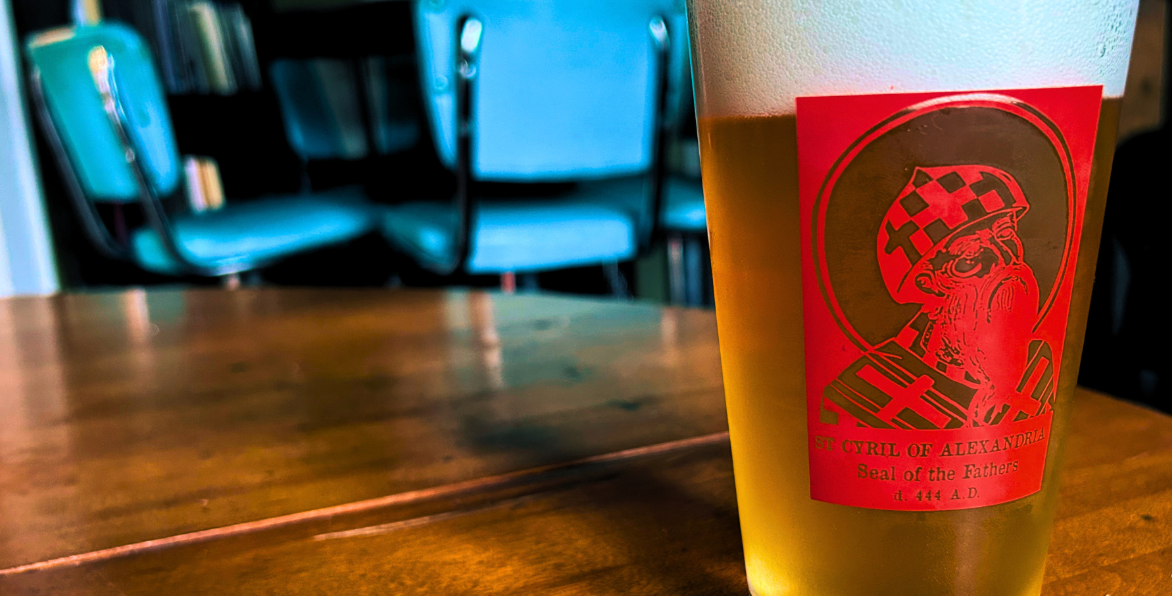
"Seal of the Fathers"
By Luke Taylor Gilstrap June 9, 2026
In Memory of Warren Farha, 1955-2026
By Jeremy Wagner May 15, 2026
An Ode to St. Brendan the Voyager
More Posts