The Hall of Men: A Concise History

by Erin Doom
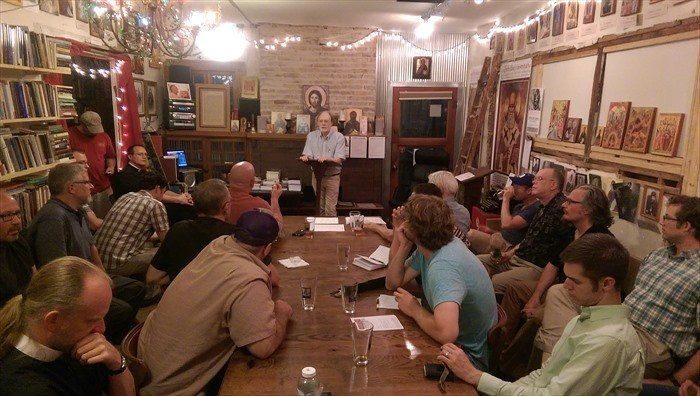
While attending Clemson University in the early 2000s, George Elder made an important decision. Instead of patronizing local college bars, he set out to recreate the atmosphere of a traditional pub. In addition to providing hand-crafted beers, public houses have historically functioned more like a community center where local citizens gather to debate the important issues of their day. In fact, it was in pubs during the early colonial period that Americans debated whether or not they should declare their independence from England. With this tradition in mind, George hand-crafted a twelve-foot-long table, built a kegerator with an intricately designed, hand-carved casing, and prominently displayed an image of one of his heroes in his garage. In other words, George converted his garage into a pub-like space ready for manly debate and discussion. Soon thereafter, young men began meeting regularly to feast on a home-cooked meal with home-brewed beer and a short presentation on a hero. Each meeting ended with toasts and stimulated great discussion about how men should live as Christians in 21st century America. Thus began the Hall of Men. 


After graduating from Clemson, many garage-filled and hero-challenging feasts later, George returned to his home in Wichita, Kansas. When George told me he was looking for a new home for his table and wanted to continue the Hall of Men, I was intrigued. But when he described the format, especially how they displayed an image of the hero, I was totally sold. I had recently become an Orthodox Christian and St. John of Damascus’ seventh-century defense of icons had been a crucial text in my conversion (that’s another story to be told). Not only was the main hall in The Ladder a perfect fit for George’s table, but the emphases on home economy, craftsmanship, and the emulation of heroes all contributed to the fulfillment of the stated objectives of Eighth Day Institute (then called St. John of Damascus Institute). An immediate partnership was thus born and well over a decade later the tradition of the Hall of Men continues to thrive in Wichita.


On the second and fourth Thursdays of each month, men gather at The Ladder for a feast of food, fellowship, teaching, and pipes & pints. Doors open at 7:00 p.m., food is served around 7:30, and the evening events officially begin around 8:30 with the Eighth Day Convocation: prayers, hymn, reading from the Fathers, Gospel reading, Christ’s prayer for unity in John 17, Nicene creed, and Lord’s Prayer. Immediately following convocation there is a short presentation on a hero whose life inspires us to be more like Christ, thereby promoting the renewal of our culture. For a glimpse of the great cloud of witnesses who surround us at each meeting, CLICK HERE to see a notebook that contains all the heroes who have been presented. And we hope to soon have a year-by-year gallery of the heroes here on our website with a short summary of their lives. But more importantly, we hope you can join us in person sometime soon. If you’re too far away from Wichita, you should consider starting your own chapter (more information on how to do this forthcoming in 2022).

Share this Post on Your Preferred Platform

By Luke Taylor Gilstrap July 31, 2026
"What is it that has ordered the things of heaven and those of earth, the things which move through the air and those which move in the water; nay, rather the things which proceeded them: heaven and earth and the natures of fire and water? What is it that combined and arranged them...set them into motion and put them on their unceasing and unhindered course?..But who is the architect of these things? Or did not he who made them also bring them into being? We shall certainly not attribute such power to spontaneity." On the Orthodox Faith, Chapter 3 This comes after St. John of Damascus sets out to delineate between the created and the uncreated, a fact which, while at the core of existence, seems for him to be, for this very reason, the simplest to believe. Everything but God is created and, thus, susceptible to change. This means people, but this also means demons, angels, the rest of the created order across the entire cosmos. Everything is vulnerable to unrest. Except for God. If you have ever tried to explain the Holy Trinity to a child for the first time, maybe you have felt as I have the weightier, inexpressible side of God's unchangeability: how do I possibly communicate this essential fact to the person in front of me? (This is usually when my faint stutter starts to pop up again.) I like that here, like St. Patrick reaching for a three-leaf clover, St. John brings us back to earth to better understand the cosmos. Fire and water are no less mysteries than heaven and earth. And yet here we are, cooking and washing, eating and drinking, filled and sustained on what we can neither fully explain nor claim to have created. Only God is unchanging. Vice versa, God is the only constant we need. Maybe the rest is better left unsaid. LUKE TAYLOR GILSTRAP is Vice President of the Board of Directors for Eighth Day Institute. His poems have appeared in Spiritus, Ekstasis (Christianity Today), and Relief Journal, among others. He lives happily in Wichita, Kansas with his wife and three sons.
By Luke Taylor Gilstrap July 24, 2026
"Now, one who would speak or hear about God should know beyond any doubt that in what concerns theology and the Incarnation not all things are inexpressible and not all are capable of expression, and neither are all things unknowable nor are they all knowable. That which can be known is one thing, whereas that which can be said is another, just as it is one thing to speak and another to know. Furthermore, many of those things about God which are not clearly perceived cannot be fittingly described, so that we are obliged to express in human terms things which transcend the human order. Thus, for example, in speaking about God we attribute to Him sleep, anger, indifference, hands and feet, and the like." On the Orthodox Faith, Chapter 2 When I was studying Fiction in graduate school, one of the first methods I learned to really situate the reader in the story you were about to tell them was disorientation; if you wanted to ground them in one story, first you had pull the rug out from under their feet. So it's fitting that in the beginning of St. John Damascene's On the Orthodox Faith, before rebuilding our foundation, he first puts us squarely in limbo, seesawing back and forth between certainty and uncertainty. To paraphrase, there is no doubt (certainty) that about God some things can be expressed...but not all things (uncertainty). Some things about God are truly knowable (certainty), but some are unknowable (uncertainty). Oh, and while we're speaking about God (certainty), let's admit there's a gap, too, between what we say and what we know (uncertainty). My favorite line in this spiraling excerpt, "...it is one thing to speak, and another to know," takes me back to the final lines in Wendell Berry's poem, "How to Be a Poet," which he wrote primarily as a reminder to himself: Accept what comes from silence. Make the best you can of it. Of the little words that come out of the silence, like prayers prayed back to the one who prays, make a poem that does not disturb the silence from which it came. Wherever your preferences fall on the cataphatic or apophatic spectrum of theology (whether you lean more toward what we can say about God or what we cannot), Berry's poem, I think, would nod along with St. John: before we say too much, let our words be preserved by the silence from which they came. I'm thinking of the silence, that filling, restorative quiet I feel when I step into a cathedral or in some of my favorite moments with my kids in the early hours. Even before praying, can we hear the One already praying in us? ​​​​​​​Let's start there. LUKE TAYLOR GILSTRAP is Vice President of the Board of Directors for Eighth Day Institute. His poems have appeared in Spiritus, Ekstasis (Christianity Today), and Relief Journal, among others. He lives happily in Wichita, Kansas with his wife and three sons.
By Mark C. Watney July 20, 2026
Late-Night Bookstores and Spiritual Reading
By Sarah Orner July 20, 2026
On St. Benedict and the Making of Vows
By Luke Taylor Gilstrap July 20, 2026
The Pursuit of Truth in the Age of AI
By Michael Simmon July 20, 2026
On the Theology of Raising Chickens
By Luke Taylor Gilstrap July 20, 2026
G.K. Chesterton and Raising Small Children
By Fr. Mark Lovett June 9, 2026
"Seal of the Fathers"
By Luke Taylor Gilstrap June 9, 2026
In Memory of Warren Farha, 1955-2026
By Jeremy Wagner May 15, 2026
An Ode to St. Brendan the Voyager
More Posts