"And Please, Stay as Long as You Like"

Late-Night Bookstores and Spiritual Reading
In browsing through Microsynaxis over the past few years, I have noticed a recurring emphasis on reading as a spiritual discipline. Consider, example, the following essays: "Why Christians Must be Readers," "The Return of the Eighth Day Books Catalog," "Tolkien's Epic Genius: The Ring, Force, and Redemption," and "1,000 Books to Read Before You Die."


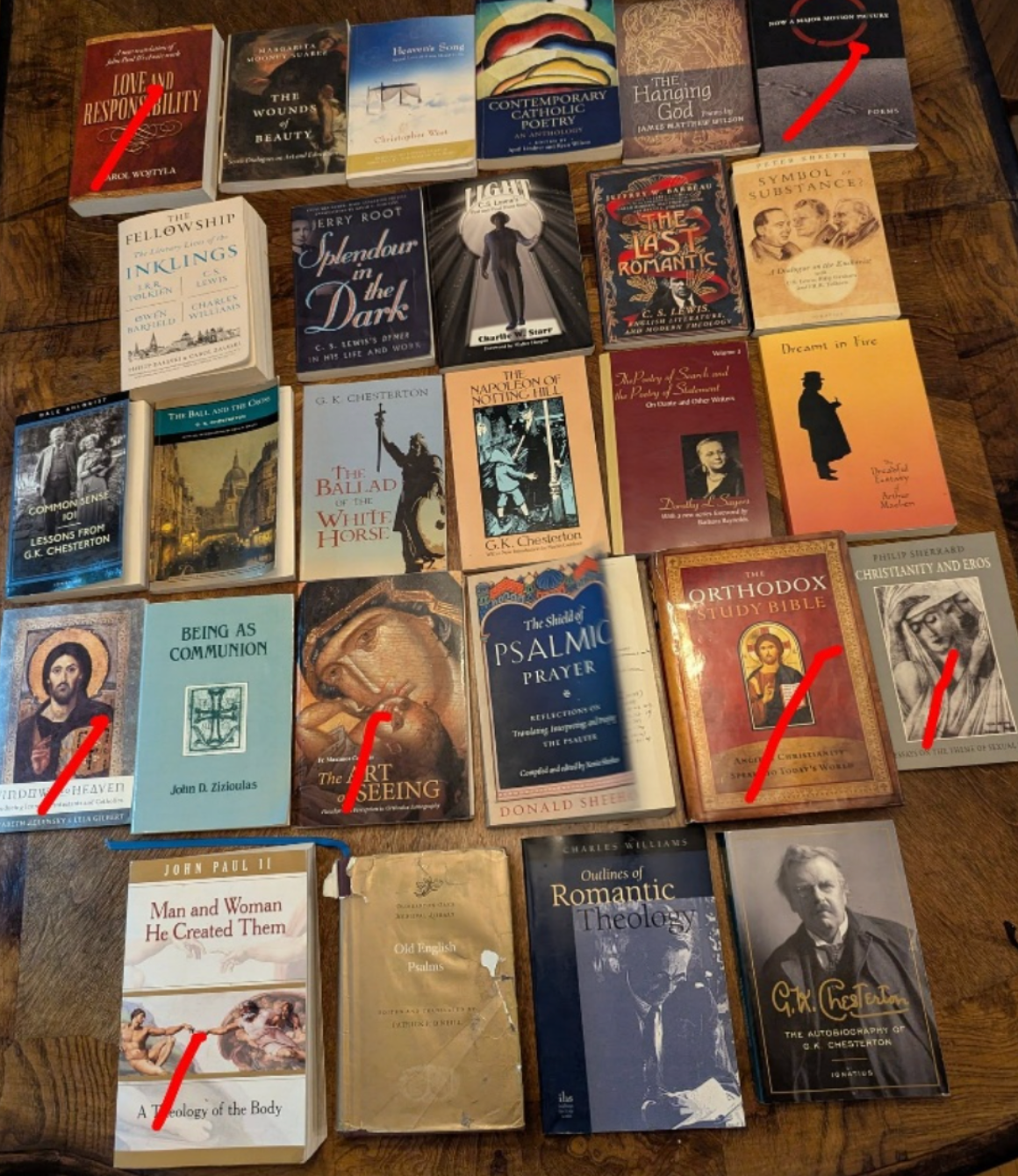
So I thought I would share the twenty-seven most influential books I have bought from Eighth Day Books during my nineteen years as an English professor at Sterling College. 


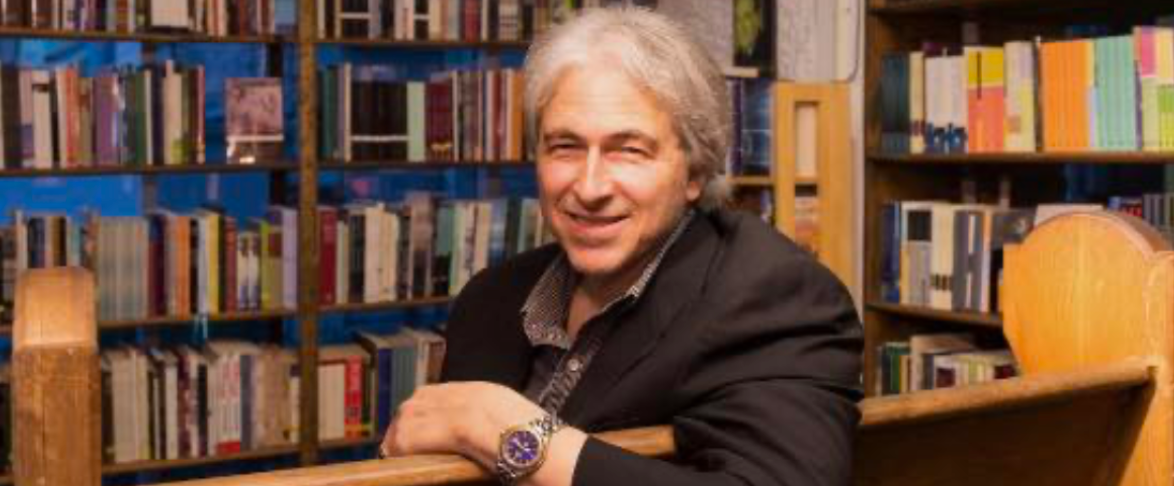
When I first arrived in Sterling, Kansas (just beneath the center staple of The Rand McNally Atlas) I was dismayed to discover that the nearest Barnes & Noble was more than an hour away in Wichita. But I soon discovered something far superior: Warren Farha's Eighth Day Books. It became my post-PhD haven. And Warren, without knowing it, had become my Kansas professor of books. Nearly all the most important books I have discovered and read during the past nineteen years came from his store, and many were books toward which he personally guided me (marked in red in the photo above). 


When I told Warren the story of my father, a Pentecostal preacher, baptizing hippies in the Indian Ocean at the southern tip of Africa in the early 1970s, he smiled and told me about his own early experiences in the Jesus Movement and his lasting affection for Pentecostals. Although he was deeply rooted in Orthodox theology, his love for, and knowledge of, other Christian traditions always amazed me.


Eighth Day became epicenter of my postdoctoral reading. That education began with the four foundational books pictured in the bottom row: Pope John Paul II's Man and Woman He Created Them; The Old English Psalms, which inspired my continuing project of rewriting the Psalter in Old English-style language; Charles Williams's Outlines of Romantic Theology, his posthumously published theology of romantic love, praised by C.S. Lewis but never granted the theological attention it deserved; and G.K. Chesterton's Autiobiography, a book he seems to have written under duress, and the last and perhaps funniest book he ever wrote.


The second row contains the Orthodox writers who have most influenced me, three of whom Warren introduced to me. And the third and fourth rows contain books on the Inklings that have guided my understanding of Tolkien, Lewis, Williams, and Chesterton.


But to understand what kind of man Warren was, however, I must tell one final story. It was ten o'clock at night. Warren had begun turning off the lights. I was lying on the carpet in the poetry section, surrounded by Dante, C.S. Lewis, and Gerard Manley Hopkins, oblivious to the darkness slowly advancing around me. Then I heard Warren cough, very politely, just above me. 


"Sorry to disturb you, Mark," he said. "I have to lock up, but..."


"No, not at all. I'll be on my way," I attempted to say. But Warren interrupted me.

​​​​​​​

"Would you mind leaving through the back door when you go? Just click the latch behind you. And please, stay as long as you like. Just switch off the lights before you leave."


I will never forget this act of outrageous hospitality and trust, leaving me, a bookaholic, alone inside a three-story bookstore while the traffic hummed outside.


It was heaven. Or as close as one can get here in Wichita.


MARK C. WATNEY is professor emeritus at Sterling College, assisting in its newly established C. S. Lewis Center. He has given papers at Harvard's Center for Hellenic Studies and Dordt College, and he is the recipient of the 2017 Jacques Maritain Award for Non-Fiction.


Share this Post on Your Preferred Platform

By Luke Taylor Gilstrap July 31, 2026
"What is it that has ordered the things of heaven and those of earth, the things which move through the air and those which move in the water; nay, rather the things which proceeded them: heaven and earth and the natures of fire and water? What is it that combined and arranged them...set them into motion and put them on their unceasing and unhindered course?..But who is the architect of these things? Or did not he who made them also bring them into being? We shall certainly not attribute such power to spontaneity." On the Orthodox Faith, Chapter 3 This comes after St. John of Damascus sets out to delineate between the created and the uncreated, a fact which, while at the core of existence, seems for him to be, for this very reason, the simplest to believe. Everything but God is created and, thus, susceptible to change. This means people, but this also means demons, angels, the rest of the created order across the entire cosmos. Everything is vulnerable to unrest. Except for God. If you have ever tried to explain the Holy Trinity to a child for the first time, maybe you have felt as I have the weightier, inexpressible side of God's unchangeability: how do I possibly communicate this essential fact to the person in front of me? (This is usually when my faint stutter starts to pop up again.) I like that here, like St. Patrick reaching for a three-leaf clover, St. John brings us back to earth to better understand the cosmos. Fire and water are no less mysteries than heaven and earth. And yet here we are, cooking and washing, eating and drinking, filled and sustained on what we can neither fully explain nor claim to have created. Only God is unchanging. Vice versa, God is the only constant we need. Maybe the rest is better left unsaid. LUKE TAYLOR GILSTRAP is Vice President of the Board of Directors for Eighth Day Institute. His poems have appeared in Spiritus, Ekstasis (Christianity Today), and Relief Journal, among others. He lives happily in Wichita, Kansas with his wife and three sons.
By Luke Taylor Gilstrap July 24, 2026
"Now, one who would speak or hear about God should know beyond any doubt that in what concerns theology and the Incarnation not all things are inexpressible and not all are capable of expression, and neither are all things unknowable nor are they all knowable. That which can be known is one thing, whereas that which can be said is another, just as it is one thing to speak and another to know. Furthermore, many of those things about God which are not clearly perceived cannot be fittingly described, so that we are obliged to express in human terms things which transcend the human order. Thus, for example, in speaking about God we attribute to Him sleep, anger, indifference, hands and feet, and the like." On the Orthodox Faith, Chapter 2 When I was studying Fiction in graduate school, one of the first methods I learned to really situate the reader in the story you were about to tell them was disorientation; if you wanted to ground them in one story, first you had pull the rug out from under their feet. So it's fitting that in the beginning of St. John Damascene's On the Orthodox Faith, before rebuilding our foundation, he first puts us squarely in limbo, seesawing back and forth between certainty and uncertainty. To paraphrase, there is no doubt (certainty) that about God some things can be expressed...but not all things (uncertainty). Some things about God are truly knowable (certainty), but some are unknowable (uncertainty). Oh, and while we're speaking about God (certainty), let's admit there's a gap, too, between what we say and what we know (uncertainty). My favorite line in this spiraling excerpt, "...it is one thing to speak, and another to know," takes me back to the final lines in Wendell Berry's poem, "How to Be a Poet," which he wrote primarily as a reminder to himself: Accept what comes from silence. Make the best you can of it. Of the little words that come out of the silence, like prayers prayed back to the one who prays, make a poem that does not disturb the silence from which it came. Wherever your preferences fall on the cataphatic or apophatic spectrum of theology (whether you lean more toward what we can say about God or what we cannot), Berry's poem, I think, would nod along with St. John: before we say too much, let our words be preserved by the silence from which they came. I'm thinking of the silence, that filling, restorative quiet I feel when I step into a cathedral or in some of my favorite moments with my kids in the early hours. Even before praying, can we hear the One already praying in us? ​​​​​​​Let's start there. LUKE TAYLOR GILSTRAP is Vice President of the Board of Directors for Eighth Day Institute. His poems have appeared in Spiritus, Ekstasis (Christianity Today), and Relief Journal, among others. He lives happily in Wichita, Kansas with his wife and three sons.
By Sarah Orner July 20, 2026
On St. Benedict and the Making of Vows
By Luke Taylor Gilstrap July 20, 2026
The Pursuit of Truth in the Age of AI
By Michael Simmon July 20, 2026
On the Theology of Raising Chickens
By Luke Taylor Gilstrap July 20, 2026
G.K. Chesterton and Raising Small Children
By Fr. Mark Lovett June 9, 2026
"Seal of the Fathers"
By Luke Taylor Gilstrap June 9, 2026
In Memory of Warren Farha, 1955-2026
By Jeremy Wagner May 15, 2026
An Ode to St. Brendan the Voyager
By Luke Taylor Gilstrap May 11, 2026
Materialism vs. Liturgical Life
More Posts