Running the Race

by Erin Doom


Feast of St Lucia the Virgin Martyr

Anno Domini 2021, December 13

This slightly extended (and late) issue of Microsynaxis concludes the Giving Tuesday “Running for Renewal” campaign. The four pieces below barely scratch the surface of the content I have on running and faith. (I have eight meditations, eight essays, and sixteen quotes, and am toying with the idea of converting the material into a book.)


Check out the material below and please do consider contributing to the campaign, which closes at midnight tonight.


Memberships are still discounted: $88 for Friend, $440 for Patron, and $880 for Pillar. In addition to the normal perks, you’ll also receive a two-day pass to the Symposium, the inaugural issue of The Christian News-Letter, and a pound of the Eighth Day Winter Blend coffee. And if you live in or near Wichita, you’ll be able to attend the members only Nativity Feast.


Click here for registration and more information about the Nativity Feast.


Click here for registration and more information about the Symposium.


Now dig in. And may it renew your soul so you can help renew your city and our culture!


In Christ,
Erin “John” Doom
Founder & Director,
Eighth Day Institute
 

1. Bible: Hebrews 12:1-11
Therefore we also, since we are surrounded by so great a cloud of witnesses, let us lay aside every weight, and the sin which so easily ensnares us, and let us run with endurance the race that is set before us, 
looking unto Jesus, the author and finisher of our faith, who for the joy that was set before Him endured the cross, despising the shame, and has sat down at the right hand of the throne of God. For consider Him who endured such hostility from sinners against Himself, lest you become weary and discouraged in your souls. You have not yet resisted to bloodshed, striving against sin. And you have forgotten the exhortation which speaks to you as to sons:


“My son, do not despise the chastening of the Lord,
Nor be discouraged when you are rebuked by Him;
 
For whom the Lord loves He chastens,
And scourges every son whom He receives.”


If you endure chastening, God deals with you as with sons; for what son is there whom a father does not chasten? But if you are without chastening, of which all have become partakers, then you are illegitimate and not sons. Furthermore, we have had human fathers who corrected, and we paid them respect. Shall we not much more readily be in subjection to the Father of spirits and live? 10 For they indeed for a few days chastened us as seemed best to them, but He for our profit, that we may be partakers of His holiness. 11 Now no chastening seems to be joyful for the present, but painful; nevertheless, afterward it yields the peaceable fruit of righteousness to those who have been trained by it.


2. Essays et al: "Let Us Run with Patience the Race That Is Set Before Us" by Mark Mosley
Dr. Mosley was my first running buddy back in 2019. He has always had to run much slower with me, but he was patient enough to join me for my first half marathon and my first full marathon. And he joined me for 7.34 of the 88 miles I recently ran. I love his writing and in between laps at the backyard ultrathon I asked him to write a reflection on running. Within a day or two, he sent me this great piece. Here’s a sample from the middle of his reflection:


I have chosen five elements of the Olympic race which are essential features to illustrate the life of salvation in Christ:


1) You will suffer. The race is a difficult struggle.


2) You are not guaranteed a victory. You must finish the race well. (You will not find support for “once saved, always saved” in this illustration.)


3) You must maintain hope in order to endure with patience. You must run with intensity while running relaxed. Keep your eyes ahead of you (and your mind above you) while letting your body move in a way for which it has been properly trained.


4) Part of the trust and hope comes from knowing the set path that you are running. This is a race set before us. While the specifics of the race may be unknown, the course and the goal are not created on the fly by the participant. You know what you are in for with the set path.


5) The “sin” of running is not running with pain and injury (this is expected and even anticipated for the athlete). Neither is the failure of the race due to not training as well as you should have (however ill-advised that may be). Rather the “sin” that leads to death is about how you ran the race— were you “running off course?”; did you “miss the mark?”; and did you “make your own way?” “The way” is not about your running form, or infractions of the race—it is staying on the right path till the finish line. The crown of victory is placed and the good news of the Son of God is spread throughout the kingdom only when the athlete crosses the finish line with the words, “Well done my good and faithful servant.”


Read the whole thing here.


3. Essays et al: "A Theology of Everything" by Chris Kettler and "Why I Run: Eight Theses Toward a Theology of Running" by Erin Doom
I also asked my friend Chris Kettler to write a short, two-paragraph meditation on why there should be a “theology of everything.”
You can read his response here.


As a preliminary stab at thinking about a theology of running, I’ve put together eight brief theses. You can read them here.

Share this Post on Your Preferred Platform

By Luke Taylor Gilstrap July 31, 2026
"What is it that has ordered the things of heaven and those of earth, the things which move through the air and those which move in the water; nay, rather the things which proceeded them: heaven and earth and the natures of fire and water? What is it that combined and arranged them...set them into motion and put them on their unceasing and unhindered course?..But who is the architect of these things? Or did not he who made them also bring them into being? We shall certainly not attribute such power to spontaneity." On the Orthodox Faith, Chapter 3 This comes after St. John of Damascus sets out to delineate between the created and the uncreated, a fact which, while at the core of existence, seems for him to be, for this very reason, the simplest to believe. Everything but God is created and, thus, susceptible to change. This means people, but this also means demons, angels, the rest of the created order across the entire cosmos. Everything is vulnerable to unrest. Except for God. If you have ever tried to explain the Holy Trinity to a child for the first time, maybe you have felt as I have the weightier, inexpressible side of God's unchangeability: how do I possibly communicate this essential fact to the person in front of me? (This is usually when my faint stutter starts to pop up again.) I like that here, like St. Patrick reaching for a three-leaf clover, St. John brings us back to earth to better understand the cosmos. Fire and water are no less mysteries than heaven and earth. And yet here we are, cooking and washing, eating and drinking, filled and sustained on what we can neither fully explain nor claim to have created. Only God is unchanging. Vice versa, God is the only constant we need. Maybe the rest is better left unsaid. LUKE TAYLOR GILSTRAP is Vice President of the Board of Directors for Eighth Day Institute. His poems have appeared in Spiritus, Ekstasis (Christianity Today), and Relief Journal, among others. He lives happily in Wichita, Kansas with his wife and three sons.
By Luke Taylor Gilstrap July 24, 2026
"Now, one who would speak or hear about God should know beyond any doubt that in what concerns theology and the Incarnation not all things are inexpressible and not all are capable of expression, and neither are all things unknowable nor are they all knowable. That which can be known is one thing, whereas that which can be said is another, just as it is one thing to speak and another to know. Furthermore, many of those things about God which are not clearly perceived cannot be fittingly described, so that we are obliged to express in human terms things which transcend the human order. Thus, for example, in speaking about God we attribute to Him sleep, anger, indifference, hands and feet, and the like." On the Orthodox Faith, Chapter 2 When I was studying Fiction in graduate school, one of the first methods I learned to really situate the reader in the story you were about to tell them was disorientation; if you wanted to ground them in one story, first you had pull the rug out from under their feet. So it's fitting that in the beginning of St. John Damascene's On the Orthodox Faith, before rebuilding our foundation, he first puts us squarely in limbo, seesawing back and forth between certainty and uncertainty. To paraphrase, there is no doubt (certainty) that about God some things can be expressed...but not all things (uncertainty). Some things about God are truly knowable (certainty), but some are unknowable (uncertainty). Oh, and while we're speaking about God (certainty), let's admit there's a gap, too, between what we say and what we know (uncertainty). My favorite line in this spiraling excerpt, "...it is one thing to speak, and another to know," takes me back to the final lines in Wendell Berry's poem, "How to Be a Poet," which he wrote primarily as a reminder to himself: Accept what comes from silence. Make the best you can of it. Of the little words that come out of the silence, like prayers prayed back to the one who prays, make a poem that does not disturb the silence from which it came. Wherever your preferences fall on the cataphatic or apophatic spectrum of theology (whether you lean more toward what we can say about God or what we cannot), Berry's poem, I think, would nod along with St. John: before we say too much, let our words be preserved by the silence from which they came. I'm thinking of the silence, that filling, restorative quiet I feel when I step into a cathedral or in some of my favorite moments with my kids in the early hours. Even before praying, can we hear the One already praying in us? ​​​​​​​Let's start there. LUKE TAYLOR GILSTRAP is Vice President of the Board of Directors for Eighth Day Institute. His poems have appeared in Spiritus, Ekstasis (Christianity Today), and Relief Journal, among others. He lives happily in Wichita, Kansas with his wife and three sons.
By Mark C. Watney July 20, 2026
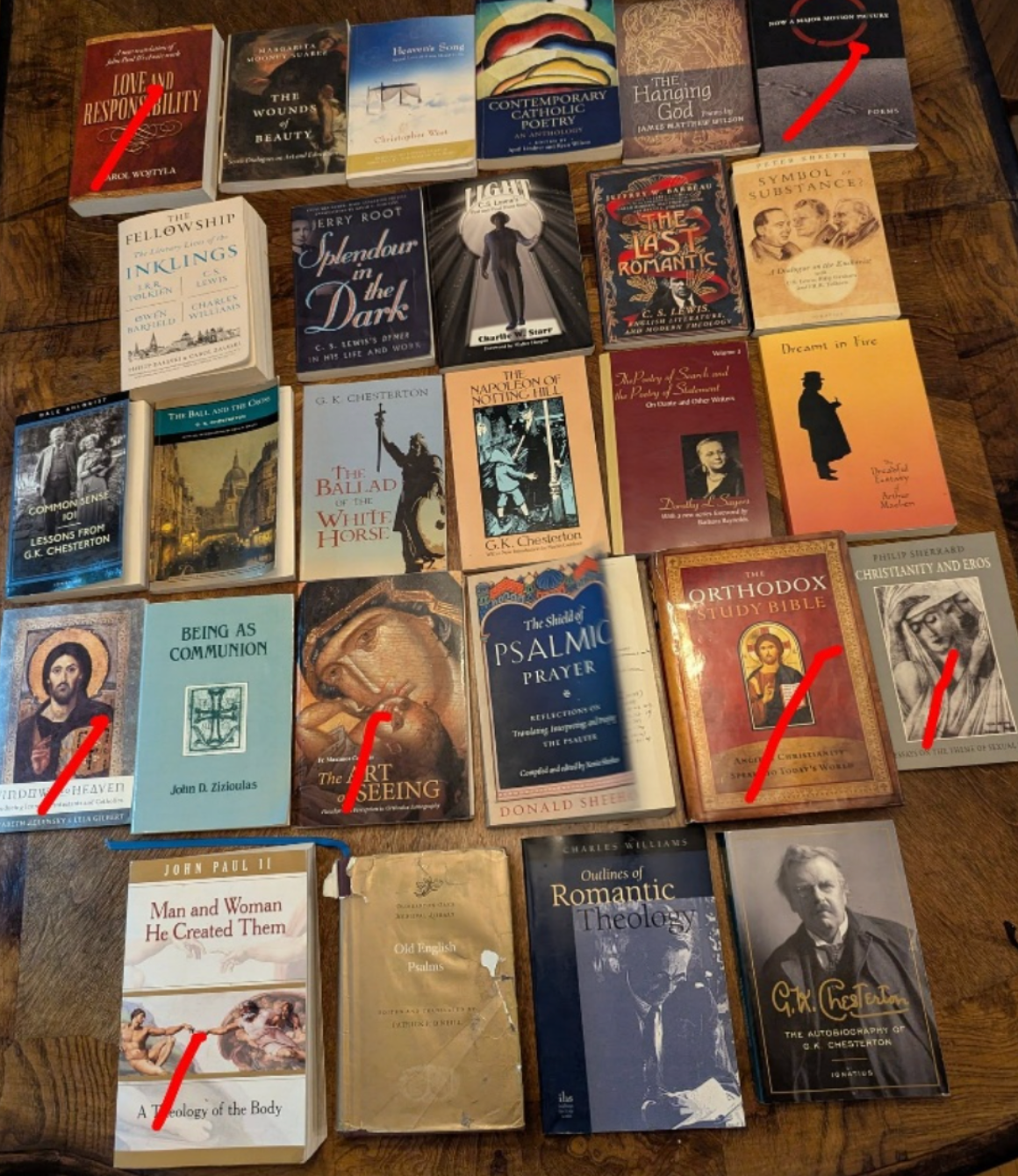
Late-Night Bookstores and Spiritual Reading
By Sarah Orner July 20, 2026
On St. Benedict and the Making of Vows
By Luke Taylor Gilstrap July 20, 2026
The Pursuit of Truth in the Age of AI
By Michael Simmon July 20, 2026
On the Theology of Raising Chickens
By Luke Taylor Gilstrap July 20, 2026
G.K. Chesterton and Raising Small Children
By Fr. Mark Lovett June 9, 2026
"Seal of the Fathers"
By Luke Taylor Gilstrap June 9, 2026
In Memory of Warren Farha, 1955-2026
By Jeremy Wagner May 15, 2026
An Ode to St. Brendan the Voyager
More Posts