Homesick at Home
by G. K. Chesterton
Feast of the Holy Prophet Haggai
Anno Domini 2021, December 16
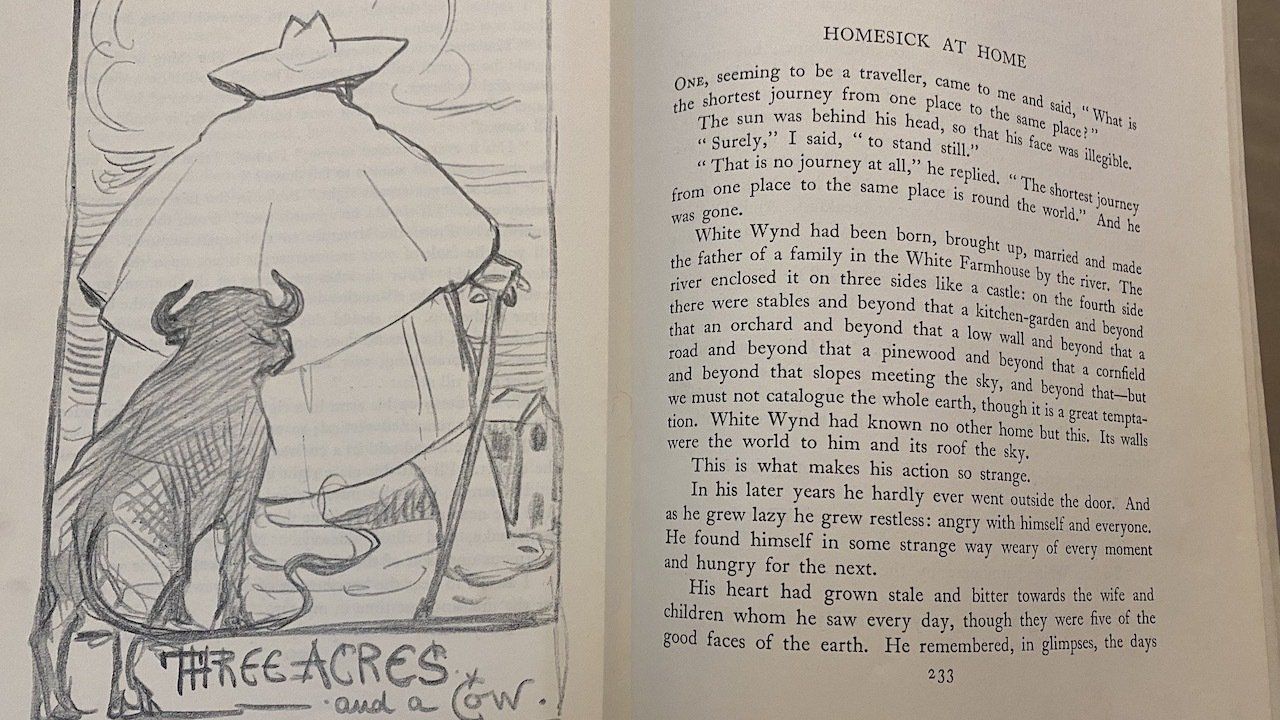
One, seeming to be a traveller, came to me and said, “What is the shortest journey from one place to the same place?”
The sun was behind his head, so that his face was illegible.
“Surely,” I said, “to stand still.”
“That is no journey at all,” he replied. “The shortest journey from one place to the same place is round the world.” And he was gone.
White Wynd had been born, brought up, married and made the father of a family in the White Farmhouse by the river. The river enclosed it on three sides like a castle: on the fourth side there were stables and beyond that a kitchen-garden and beyond that an orchard and beyond that a low wall and beyond that a road and beyond that a pinewood and beyond that a cornfield and beyond that slopes meeting the sky, and beyond that—but we must not catalogue the whole earth, though it is a great temptation. White Wynd had known no other home but this. Its walls were the world to him and its roof the sky.
This is what makes his action so strange.
In his later years he hardly ever went outside the door. And as he grew lazy he grew restless: angry with himself and everyone. He found himself in some strange way weary of every moment and hungry for the next.
His heart had grown stale and bitter towards the wife and children whom he saw every day, though they were five of the good faces of the earth. He remembered, in glimpses, the days of his toil and strive for bread, when, as he came home in the evening, the thatch of his home burned with gold as though angels were standing there. But he remembered it as one remembers a dream.
Now he seemed to be able to see other homes, but not his own. That was merely a house. Prose had got hold of him: the sealing of the eyes and the closing of the ears.
At last something occurred in his heart: a volcano; an earthquake; an eclipse; a daybreak; a deluge; an apocalypse. We might pile up colossal words, but we should never reach it.
Eight hundred times the white daylight had broken across the bare kitchen as the little family sat at breakfast. And the eight hundred and first time the father paused with the cup he was passing in his hand.
“That green cornfield through the window,” he said dreamily, “shining in the sun. Somehow, somehow it reminds me of a field outside my own home.”
“Your own home?” cried his wife. “This is your home.”
White Wynd rose to his feet, seeming to fill the room. He stretched forth his hand and took a staff. He stretched it forth again and took a hat. The dust came in clouds from both of them.
“Father,” cried one child. “Where are you going?”
“Home,” he replied.
“What can you mean? This is your home. What home are you going to?”
“To the White Farmhouse by the river.”
“This is it.”
He was looking at them very tranquilly when his eldest daughter caught sight of his face.
“Oh, he is mad!” she screamed, and buried her face in her hands.
He spoke calmly. “You are a little like my eldest daughter,” he said. “But you haven’t got the look, no, not the look which is a welcome after work.”
“Madam,” he said, turning to his thunderstruck wife with a stately courtesy. “I thank. you for your hospitality, but indeed I fear I have trespassed on it too long. And my home—”
“Father, father, answer me! Is not this your home?”
The old man waved his stick.
“The rafters are cobwebbed, the walls are rain-stained. The doors bind me, the rafters crush me. There are littlenesses and bickerings and heartburnings here behind the dusty lattices where I have dozed too long. But the fire roars and the door stands open. There is bread and raiment, fire and water and all the crafts and mysteries of love. There is rest for heavy feet on the matted floor, and for starved heart in the pure faces, far away at the end of the world, in the house where I was born.”
“Where, where?”
“In the White Farmhouse by the river.”
And he passed out of the front door, the sun shining on his face.
And the other inhabitants of the White Farmhouse stood staring at each other.
White Wynd was standing on the timber bridge across the river, with the world at his feet.
And a great wind came flying from the opposite edge of the sky (a land of marvellous pale golds) and met him. Some may know what that first wind outside the door is to a man. To this man it seemed that God had bent back his head by the hair and kissed him on the forehead.
He had been weary with resting, without knowing that the whole remedy lay in sun and wind and his own body. Now he half believed that he wore the seven-leagued boots.
He was going home. The White Farmhouse was behind every wood and beyond every mountain wall. He looked for it as we all look for fairyland, at every turn of the road. Only in one direction he never looked for it, and that was where, only a thousand yards behind him, the White Farmhouse stood up, gleaming with thatch and whitewash against the gusty blue of morning.
He looked at the dandelions and crickets and realised that he was gigantic. We are too fond of reckoning always by mountains. Every object is infinitely vast as well as infinitely small.
He stretched himself like one crucified in an uncontainable greatness.
“Oh God, who hast made me and all things, hear four songs of praise. One for my feet that Thou hast made strong and light upon Thy daisies. One for my head, which Thou hast lifted and crowned above the four corners of Thy heaven. One for my heart, which Thou hast made a heaven of angels singing Thy glory. And one for that pearl-tinted cloudlet far away above the stone pines on the hill.”
He felt like Adam newly created. He had suddenly inherited all things, even the suns and stars.
Have you ever been out for a walk?
---------------
The story of the journey of White Wynd would be an epic. He was swallowed up in huge cities and forgotten: yet he came out on the other side. He worked in quarries, and in docks in country after country. Like a transmigrating soul, he lived a series of existences: a knot of vagabonds, a colony of workmen, a crew of sailors, a group of fishermen, each counted him a final fact in their lives, the great spare man with eyes like two stars, the stars of an ancient purpose.
But he never diverged from the line that girdles the globe.
On a mellow summer evening, however, he came upon the strangest thing in all his travels. He was plodding up a great dim down, that hid everything, like the dome of the earth itself.
Suddenly a strange feeling came over him. He glanced back at the waste of turf to see if there were any trace of boundary, for he felt like one who has just crossed the border of elfland. With his head a belfry of new passions, assailed with confounding memories, he toiled on the brow of the slope.
The setting sun was raying out a universal glory. Between him and it, lying low on the fields, there was what seemed to his swimming eyes a white cloud. No, it was a marble palace. No, it was the White Farmhouse by the river.
He had come to the end of the world. Every spot on earth is either the beginning or the end, according to the heart of man. That is the advantage of living on an oblate spheroid
It was evening. The whole swell of turf on which he stood was turned to gold. He seemed standing in fire instead of grass. He stood so still that the birds settled on his staff.
All the earth and the glory of it seemed to rejoice round the madman’s homecoming. The birds on their way to their nests knew him, Nature herself was in his secret, the man who had gone from one place to the same place.
But he leaned wearily on his staff. Then he raised his voice once more.
“O God, who hast made me and all things, hear four songs of praise. One for my feet, because they are sore and slow, now that they draw near the door. One for my head, because it is bowed and hoary, now that Thou crownest it with the sun. One for my heart, because Thou hast taught it in sorrow and hope deferred that it is the road that makes the home. And one for that daisy at my feet.”
He came down over the hillside and into the pinewood. Through the trees he could see the red and gold sunset settling down among the white farm-buildings and the green apple-branches. It was his home now. But it could not be his home till he had gone out from it and returned to it. Now he was the Prodigal Son.
He came out of the pinewood and across the road. He surmounted the low wall and tramped through the orchard, through the kitchen garden, past the cattle-sheds. And in the stony courtyard he saw his wife drawing water.
*Originally published in G. K. Chesterton, The Coloured Lands (London: Sheed and Ward, 1938), pp. 233-238.
Share this Post on Your Preferred Platform