Patrick Doom
A Hero Worthy of Imitation
by Erin Doom
Feast of St Symeon the New Theologian
Anno Domini 2019, March 12
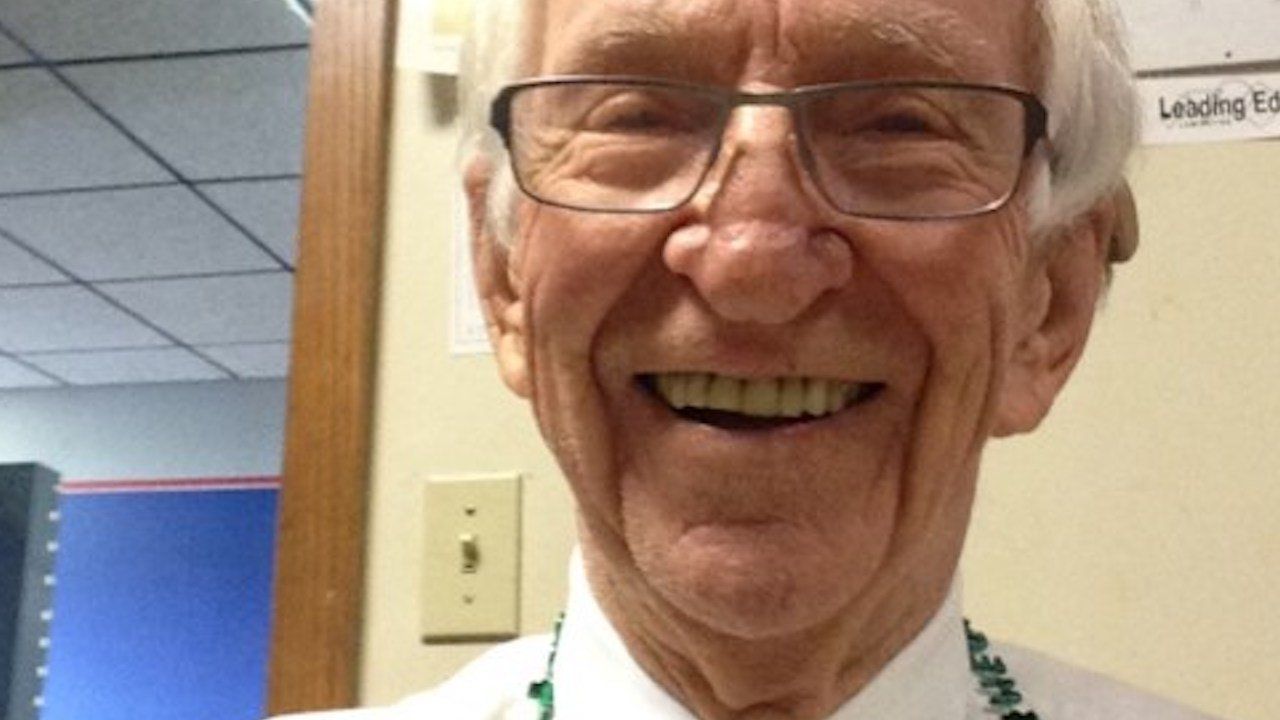
MY GRANDFATHER departed this life on Feb. 6 in the year of our Lord 2019. He was born on St. Patrick's Day in the year of our Lord 1925 and thus named after St. Patrick. Our eleventh annual Feast of St. Patrick is dedicated to his memory. Here is the eulogy I offered at his memorial service. May the memory of Patrick Doom and St. Patrick be eternal!
There is so much to tell you about my grandfather Patrick Doom. When I sat down to think about what good words I wanted to say about him (that is what the word "eulogy" means, based on the Greek roots:
eu
: good; and
logos
: word), I quickly generated seven pages of notes. And I had barely gotten started. So instead of going on and on I decided to limit myself by going back to the short response I offered via text message as soon as I received word of his death: “A true hero...We need more men like him today. May his memory be eternal!” That’s how I’d like to frame my remarks today.
1. A TRUE HERO…
Who do we as a culture celebrate today as heroes? That’s a simple question with an extremely easy and obvious answer: celebrities, especially in the entertainment industry of movies and sports.
Do you know what happens when we idolize heroes? We imitate them. And what happens when we imitate them? We become more and more like them.
So the real question we should all consider today is: “Who do we want to be like?” Once we can answer that question, we’ll know who our heroes should be. And then, after we have selected our heroes, we will start imitating them and becoming more like them.
When I consider this question, “Who do I want to be like?”, my answer is twofold: Christ and men like my Grandpa Pat. I include my grandfather not
just
because he served in WWII. Don’t get me wrong. He is definitely a war hero. He was a paratrooper in the 17th Airborne Division who served as a parachute instructor, received ribbons for European Theater of Operations with two battle stars, denoting action in Italy and Sicily, a Good Conduct Ribbon, and a Combat Infantry Badge. But for me, he is a hero for three additional reasons. And those three reasons explain
why we need more men today like Patrick Doom.
2. WE NEED MORE MEN LIKE HIM TODAY.
Why do we need more men like my grandfather today? I’m a history buff and I’m especially interested in early Christian history. So to answer this question, I’m compelled to go back to the fourth and fifth centuries, to the man after whom my grandfather is named: St. Patrick the Enlightener of Ireland.
I’d love to tell you all about his amazing life, but that must be saved for another time ( you can learn more about him at Eighth Day Institute’s annual Feast of St Patrick – information and registration here). For now, let me just share a few details. First, St. Patrick was a Brit. Did you know that? He was also kidnapped and enslaved. Bet you didn’t realize that!
At the young age of sixteen St. Patrick was captured and kidnapped from Britannia by Irish raiders and sold as a slave in Ireland, where he was force to work as a shepherd. While working, he found God. According to his own account in his Confession :
After I came to Ireland—every day I had to tend sheep, and many times a day I prayed—the love of God and His fear came to me more and more, and my faith was strengthened…. I used to get up for prayer before daylight, through snow, through frost, through rain, and I felt no harm, and there was no sloth in me... ~ Confession 16
He went on to become the spiritual Father of Ireland, hence the “Enlightener of Ireland.”
So what does the life of St. Patrick have to do with the life of Patrick Doom? St. Patrick’s life helps explain why Grandpa Pat is my hero and why we need more men like him today.
1) Where did St. Patrick find God? While working. My grandfather is one of the hardest working men I’ve ever known. He didn’t retire from running Fast Print, his family print shop, until he was ninety years old. But even then, he didn’t actually retire. For he and his wife Linda continued to work together in the real estate business, owning and managing many rental properties.
I mention Linda for a reason. Pat and Linda ran Fast Print together. It was a family business. And their children, Michelle and Ryan, were just as much a part of that business. I even had a tiny part in it at the age of fourteen: it was my first part-time job. And now Michelle and her husband Jason own and operate it. So my grandfather’s long life of hard work was always within the context of his family. And that is not insignificant in our day and age.
Today, we tend to think work and pleasure must be separated. We work from nine to five and then go home for pleasure in the evenings. We work five days a week so we can have the weekend for relaxation. We take a week vacation from our annual routine of work and we retire from work altogether at the age of sixty-five, all for pleasure. Wendell Berry, one of my favorite novelists and essayists, writes about this in an essay titled “What Are People For?” Here’s what he has to say:
We recognize defeated landscapes by the absence of pleasure from them. We are defeated at work because our work gives us no pleasure. We are defeated at home because we have no pleasant work there. We turn to the pleasure industries for relief from our defeat, and are again defeated, for the pleasure industries can thrive and grow only upon our dissatisfaction with them.
Where is our comfort but in the free, uninvolved, finally mysterious beauty and grace of this world that we did not make, that has no price? Where is our sanity but there? Where is our pleasure but in working and resting kindly in the presence of this world?
Whether he was working at Fast Print, on a rental home—often times with my dad or one of my brothers—or at home, my grandfather found pleasure in his work. He worked and rested in the presence of this world, and especially in the presence of his family and friends. We need more men today like my grandfather, men who never tire of working hard, who are committed to working not only for their families but also with them.
2) What did St. Patrick do while working? He prayed. Separated from his family by force, St. Patrick found himself alone working in solitude as a shepherd for his master. It was during this time, while working as a slave, that he found himself in the presence of God. And he began to commune with God on a regular basis through prayer. He became a man of prayer. So did my grandfather.
I didn’t know this about Grandpa Pat. But he recently told my father how important prayer had become for him. He didn’t pray for stuff. He prayed for people, for his family, and for his friends. He prayed on a regular basis, fulfilling St. Paul’s injunction to pray without ceasing (1 Thess. 5:17). And his prayers bore fruit, as did those of St. Patrick.
3) Who did St. Patrick become? A father. Through the work and prayers of St. Patrick, the people of Ireland were enlightened by the Good News of Christ. He became the spiritual father of an entire nation.
While my grandpa Pat is not the spiritual father of a whole country, the fruit of his work and prayers can be seen clearly in the lives of his five children, his nine grandchildren, and his fourteen great-grandchildren. I thank God every day for my father, for the man my grandfather raised and shaped. My dad, Mike Doom, learned the value of hard work and prayer from my grandfather. Thanks to my grandfather, my dad is also a true hero.
Ora et labora
is the Latin phrase for “pray and work.” It is a common expression used to encapsulate the life of a monk like St. Patrick, whose life was spent praying and working. In my books that is a real man, a true hero, a great father. Like St. Patrick, my grandfather Pat lived a life of prayer and work, of
ora et labora. So he’s a real man, a true hero, and a great father. We need more men like my grandfather Pat and my father Mike.
3. MAY HIS MEMORY BE ETERNAL.
There is an ancient prayer that the Orthodox Christian tradition prays for the departed: “May his / her memory be eternal.” This short and simple prayer is based on the belief that the saints are alive in Christ. Now that my Grandpa Pat has departed this life, it’s not our responsibility to try to “get over” his death or to “move beyond” his departure. We believe he is alive in Christ. We believe he is living in communion with the great cloud of witnesses we read about in the Epistle to the Hebrews.
We also believe Grandpa Pat remains alive to and for us. How so? Let me explain by reading a short passage from the journals of a 19th century Russian priest, St. John of Kronstadt. And then I’ll conclude with a short prayer.
As you are aware, man, in his words, does not die; he is immortal in them and they will speak after his death. I shall die, but shall speak even after death. How many immortal words are in use amongst the living, which were left by those who have died long ago and which sometimes still live in the mouths of a whole people! [Think of St Patrick!] How powerful is the word even of an ordinary man! …
The saints of God live even after their death. Thus, I often hear in church the Mother of God singing her wonderful, heart-penetrating song which she said in the house of her cousin Elizabeth, after the Annunciation of the Archangel. At times, I hear the song of Moses; the song of Zacharias – the father of the Forerunner; that of Hannah, the mother of the prophet Samuel; that of the three children; and that of Miriam. And how many holy singers of the New Testament delight until now the ear of the whole Church of God! And the Divine service itself – the sacraments, the rites? Whose spirit is there, moving and touching our hearts? That of God and of His saints. Here is a proof for you of the immortality of men’s souls. How is it that all these men have died, and yet are governing our lives after their death – they are dead and they still speak, instruct and touch us?”
In conclusion, please join me in prayer.
O Christ our God, may the memory of my grandfather Patrick Doom be eternal. May the immortal words, deeds, and amazing stories of this real man, this true hero, this great father who is worthy of imitation continue to speak to us long after his departure from this life. May he continue to speak to us, to instruct us, and to touch our lives.
O God of spirits and of all flesh, You trampled upon death and abolished the power of the devil, giving life to Your world. Give rest to the soul of Your departed servant Patrick in a place of light, in a place of green pasture, in a place of refreshment, from where pain, sorrow, and sighing have fled away. As a good and loving God, forgive every sin he has committed in word, deed, or thought, for there is no one who lives and does not sin. You alone are without sin. Your righteousness is an everlasting righteousness, and Your word is truth.
For You are the resurrection, the life, and the repose of Your departed servant Patrick, Christ our God, and to You we offer glory, with Your eternal Father who is without beginning and Your all-holy, good, and life-creating Spirit, both now and forever and to the ages of ages. Amen.
Erin Doom is the founder and director of Eighth Day Institute. He lives in Wichita, KS with his wife Christiane and their four children, Caleb Michael, Hannah Elizabeth, Elijah Blaise, and Esther Ruth.
Share this Post on Your Preferred Platform