From Ashes and Ruin: Selections from the Writings of St. Gennadios Scholarios
Foreword by Fr. Maximos Constas
Feast of the Nativity of Our Most Holy Lady the Theotokos and Ever-Virgin Mary
Anno Domini 2023, September 8
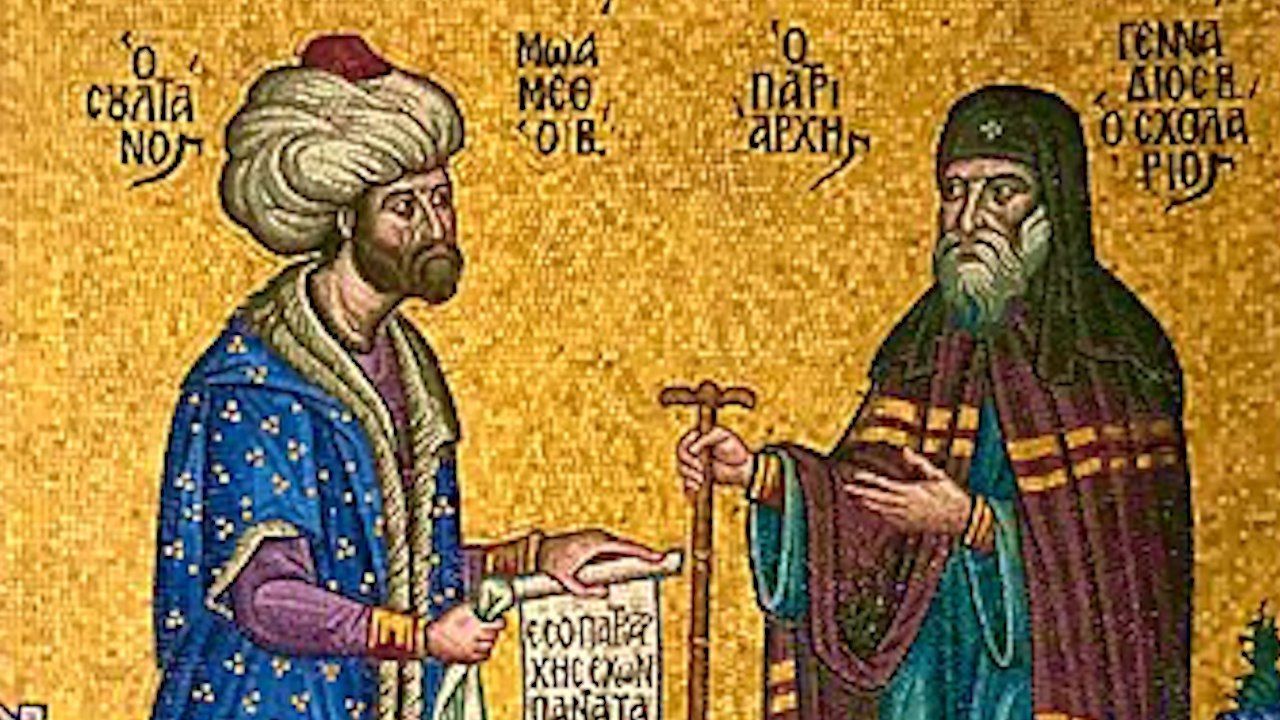
GENNADIOS SCHOLARIOS, sometimes called the “last of the Byzantines,” was the first Patriarch of Constantinople after the violent overthrow of the Byzantine state on 29 May 1453. He was a survivor of a once great civilization, the tattered remnants of which were swept away by the conquering armies of Islam. The drastically changed circumstances raised inescapable questions about the nature of one’s identity in such a strange new world. All, or nearly all, the institutions that had defined and supported his sense of self had vanished seemingly overnight. He had become, as it were, a displaced person, a stranger in the city of his birth. We tend to think of cultural dislocation as a distinctive condition of modernity, along with the social, psychological, and spiritual fragmentation that invariably accompanies it. But this condition is not new and has been faced many times throughout the Church’s long and often turbulent history.
Formerly the friend of an emperor but now the slave of a hostile and alien religion, Gennadios asked: “Who am I?” The responses to this question that perhaps came immediately to his mind were immediately rejected. “Even though I speak Greek, I would never call myself ‘Greek,’ because I do not think like them. I also speak Latin, but I am not for that reason a Latin, for neither do I think like them.” He understood clearly that language and ethnicity do not form a sufficiently profound or durable basis on which to build an identity. One’s place of birth likewise mattered little, and with the state reduced to ashes, political identities were equally useless, for what could it possibly mean to call oneself a “Roman” in a world where the Roman Empire no longer existed? What, then, was left? “I want to be named,” Gennadios declared, “according to my religion; and if anyone asks me who I am, I will respond that I am a Christian.” Stripped of the accumulated layers of ethnicity, political ideology, and social, cultural, and regional identities, Gennadios felt that, in many ways, he had returned to a pre-Constantinian moment, when the faithful not only identified themselves as Christians but also experienced a profound identification with Christ himself.
For example, more than one thousand years earlier, at the trial of Justin Martyr and his companions, the governor questioned one of them, saying, “Who are your parents?” To which he replied, “Our true father is Christ, and our mother is our faith in him.” Others refused to give their names, saying only that, “I am a Christian,” or even, “My name is Christ.” And in answer to the question, “Where are you from?” they responded by saying, “We are from Nazareth.” Like Gennadios, they knew that to identify themselves with anything transient and ephemeral—anything merely human—was to forget that “here we have no lasting city, but we seek the city which is to come” (Heb. 13:14).
We see a similar dynamic at work in the life of St. John of Damascus (ca. 675-749 AD). An outstanding theologian, the Damascene produced a compendium or epitome of Orthodox theology, known as On the Orthodox Faith, which is arguably the best known of his works. Unlike earlier systematic summaries, this was not personal but ecclesial, which the Damascene signals with his famous opening statement: “I will say nothing that is my own” (which is itself a quotation from St. Maximos the Confessor). John’s work is a monument of theological precision and clarity, two qualities which were absolutely crucial, since, not unlike Gennadios, John’s readers were living in a different world. After the fall of Syria to the Umayyad Caliphate (661-750 AD), there was no longer a Christian empire or emperor (or culture) to support the local Christian community, which now had to live side-by-side with multiple Christian sects and heretical groups under the control of a military theocracy that John of Damascus understood to be a confused form of heresy, namely, Arianism. Thus, On the Orthodox Faith was written in response to a question about Christian identity and aimed to define what it meant to be a Christian in a non-Christian world. To answer this question successfully, the Christian tradition needed to be organized, clarified, and presented in a way that made it accessible to large numbers of readers who had difficulty finding a foothold in a markedly changing society. The Cappadocian Fathers, who lived in the immediate aftermath of the Constantinian revolution, were also concerned about the formation of Christian identity in that strange new world, but here we must draw our parallel to a close.
--------
While known to scholars and historians primarily as a theological writer, Gennadios was also a pastor who authored many works designed to edify and inspire the faithful. These works touch on virtually all aspects of the life in Christ: from sin and repentance, to questions of free will, faith, prayer, fasting, Almsgiving, participation in church services, the sacraments, and the life of holiness and virtue. His teachings are clear and forthright, filled with spiritual counsel, practical advice, and deeply shaded by Scripture and inspired by the spirit of the Fathers, and thus fulfill the injunction of the Apostle Paul: “Preach the word; be prepared in season and out of season; reprove, rebuke, and encourage with every form of patient instruction” (2 Tim. 4:2). Father John Palmer is to be congratulated for making these texts available in a clear and readable translation, providing us with what is now the largest collection of works by Gennadios Scholarios in English.
*From Ashes and Ruin: Selections from the Writings of St. Gennadios Scholarios, tr. Rev. Dr. John Palmer (Columbia, MO: Newrome Press, 2022), pp. ix-xii. Available for purchase at Eighth Day Books.
Share this Post on Your Preferred Platform