Understanding Our Current Cultural Moment: Two Book Reviews on Unmediated Interpersonal Communication for Cultural Renewal

by Joshua Sturgill


Feast of St Stephen the Archdeacon and First Martyr

Anno Domini 2022, December 27
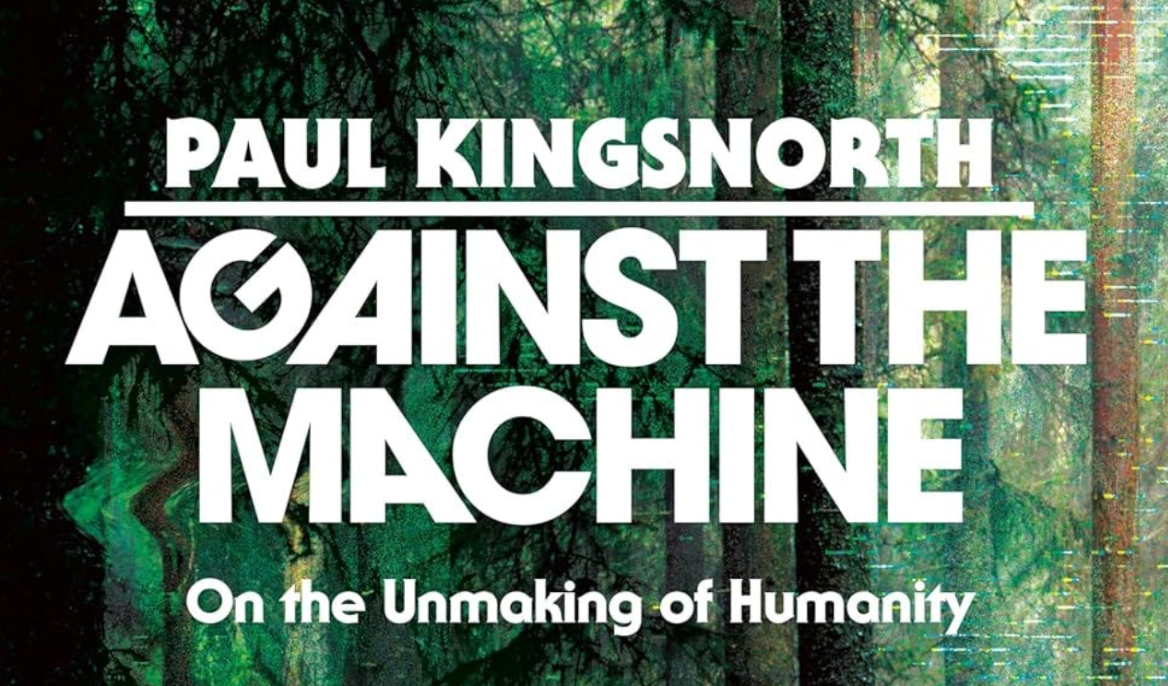
I'd like to recommend two books for understanding our current cultural moment. They're not new, but if you haven't read them, push them to the top of your list. The first is Technopoly by Neil Postman, and the second is The Master and His Emissary by Iain McGilchrist. Postman looks at the unpredictable effects of technology on society. McGilchrist begins with deep research into the neurological functions of the human brain and then compares his findings with the character of many cultures throughout history.


Among the many things these books have in common is their conclusion that for a culture to be healthy, interpersonal communications must be direct, honest and compassionate. The more media or technologies come between people, the more troubled a society becomes—less personal, less humane.

What we commonly call "culture" may become a thing of the past if face-to-face communications are lost. So the appeal I'm about to make stands on doubly shaky ground. I'm sending it as an email (rather than putting pen to paper or making a visit), and I'm asking your support for a face-to-face community which might not be your community.


We have a pile of ambiguities here: the war of print with electronic media, the instantaneous availability of images and information, the misuse of words like virtual, friend or society.

These are ambiguities which can and should be discussed. And this is where the Eighth Day Institute most proves its necessity. Our mission requires both maintaining a local community and seeking to foster community in faraway places through as many means as possible.

If you come to our events, you'll find discussions, friendships, and a genuine society. If you are an online subscriber, our hope is that you find fuel for your own, local fire.

I teach high school, and one of my favorite parts of the job is that I give a half-hour lecture every Wednesday morning on any topic. I like series, so for the first two months of this school year, I spoke about definitions of what it means to be human from around the world. For these talks, I was able to draw from the writings of Church Fathers and on discussions I've had with other EDI patrons.

For the second two months, I'm taking over-used, under-considered phrases like "science and technology" or "sanity" and giving an extended etymology for them. This week, the phrase was "social media." Socius: ally or companion; Medius: between or middle. "Social Media" has only been in use since 2008. But it's now ubiquitous. So ubiquitous, in fact, that we rarely consider that the phrase is an oxymoron.


Socius, associate, social—these words refer to intimate community and interdependence. Medius, medium, mediator—these words describe what comes between people or things. In other words, a true society needs no outside media. Yet who considers that every online encounter involves a host of corporations, advertisers, psychologists, designers—all mediating our communications?


If a complete break with technology is not possible, a decisive down-sizing is. We need a re-directing of our attention and energy toward what makes for stable, peaceful culture. Neil Postman and Iain McGilchrist understand this too well. Saints and Fathers of the ages encourage us to slow down, breathe, study, and share our lives with each other, unmediated.


Likewise, EDI is working to lessen the Medius and increase the Socius, wherever and whenever we can. Consider joining the EDI community and help us spread the word!


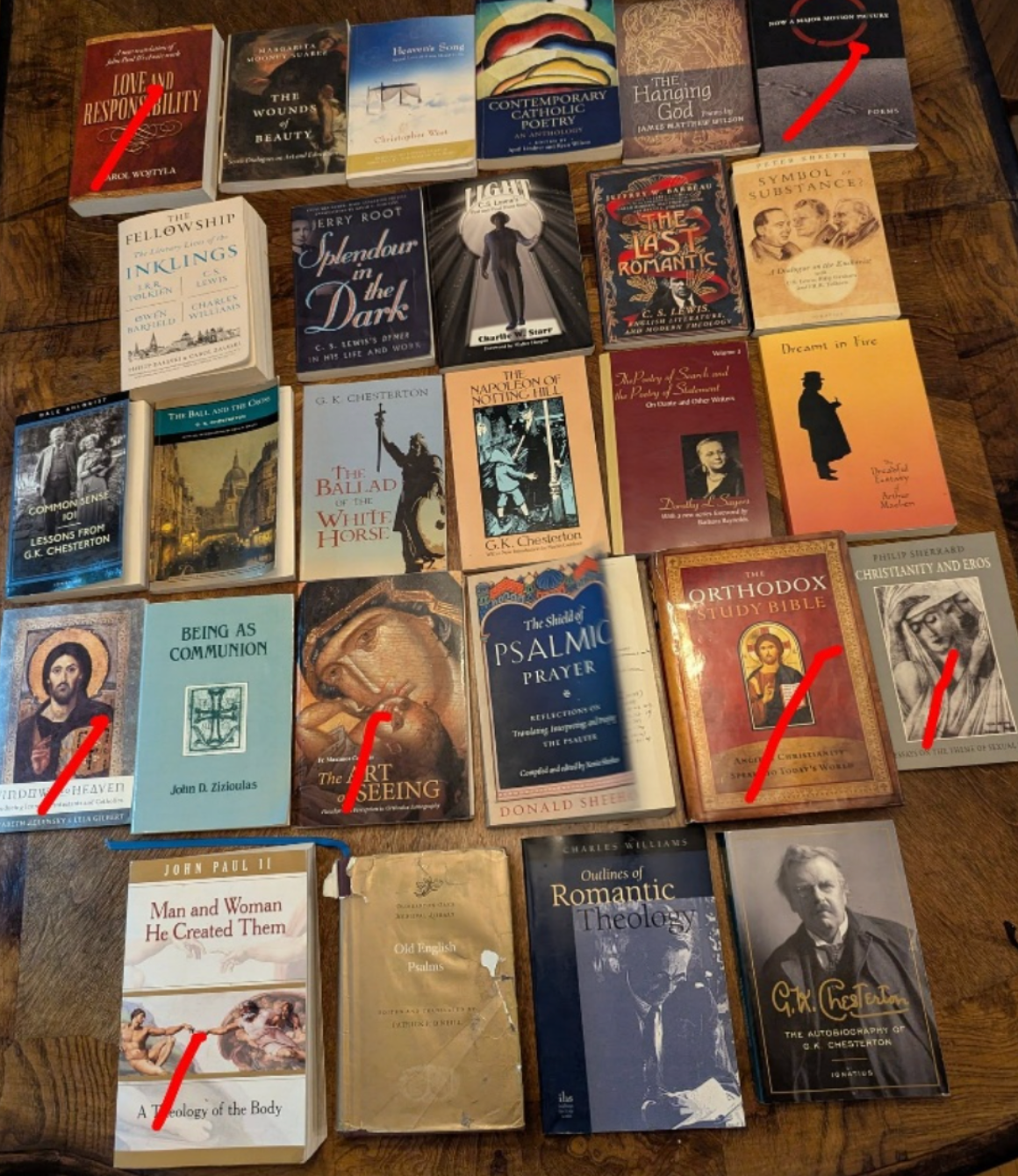
*Joshua Alan Sturgill, M.Div., M.A. has worked with Eighth Day Books and the bookstore community for more than twenty years. He is a member of St. George Orthodox Cathedral, and currently teaches philosophy and literature at Northfield School in Wichita, KS. Frequent travels for Eighth Day take him to conferences and workshops nationwide. Joshua is the author of two poetry volumes, most recently Now A Major Motion Picture, published by Darkly Bright Press. He holds a masters in divinity from Sangre de Cristo Seminary, and a master of arts in Far Eastern classics from St. John's College, Santa Fe. Joshua was a founding member of the Eighth Day Institute, serving as its first board vice president. Among his many hopes for EDI is the formation of a catechetical academy, where students (young and old) can come together for extended periods of study and conversation. 

Share this Post on Your Preferred Platform

By Luke Taylor Gilstrap July 31, 2026
"What is it that has ordered the things of heaven and those of earth, the things which move through the air and those which move in the water; nay, rather the things which proceeded them: heaven and earth and the natures of fire and water? What is it that combined and arranged them...set them into motion and put them on their unceasing and unhindered course?..But who is the architect of these things? Or did not he who made them also bring them into being? We shall certainly not attribute such power to spontaneity." On the Orthodox Faith, Chapter 3 This comes after St. John of Damascus sets out to delineate between the created and the uncreated, a fact which, while at the core of existence, seems for him to be, for this very reason, the simplest to believe. Everything but God is created and, thus, susceptible to change. This means people, but this also means demons, angels, the rest of the created order across the entire cosmos. Everything is vulnerable to unrest. Except for God. If you have ever tried to explain the Holy Trinity to a child for the first time, maybe you have felt as I have the weightier, inexpressible side of God's unchangeability: how do I possibly communicate this essential fact to the person in front of me? (This is usually when my faint stutter starts to pop up again.) I like that here, like St. Patrick reaching for a three-leaf clover, St. John brings us back to earth to better understand the cosmos. Fire and water are no less mysteries than heaven and earth. And yet here we are, cooking and washing, eating and drinking, filled and sustained on what we can neither fully explain nor claim to have created. Only God is unchanging. Vice versa, God is the only constant we need. Maybe the rest is better left unsaid. LUKE TAYLOR GILSTRAP is Vice President of the Board of Directors for Eighth Day Institute. His poems have appeared in Spiritus, Ekstasis (Christianity Today), and Relief Journal, among others. He lives happily in Wichita, Kansas with his wife and three sons.
By Luke Taylor Gilstrap July 24, 2026
"Now, one who would speak or hear about God should know beyond any doubt that in what concerns theology and the Incarnation not all things are inexpressible and not all are capable of expression, and neither are all things unknowable nor are they all knowable. That which can be known is one thing, whereas that which can be said is another, just as it is one thing to speak and another to know. Furthermore, many of those things about God which are not clearly perceived cannot be fittingly described, so that we are obliged to express in human terms things which transcend the human order. Thus, for example, in speaking about God we attribute to Him sleep, anger, indifference, hands and feet, and the like." On the Orthodox Faith, Chapter 2 When I was studying Fiction in graduate school, one of the first methods I learned to really situate the reader in the story you were about to tell them was disorientation; if you wanted to ground them in one story, first you had pull the rug out from under their feet. So it's fitting that in the beginning of St. John Damascene's On the Orthodox Faith, before rebuilding our foundation, he first puts us squarely in limbo, seesawing back and forth between certainty and uncertainty. To paraphrase, there is no doubt (certainty) that about God some things can be expressed...but not all things (uncertainty). Some things about God are truly knowable (certainty), but some are unknowable (uncertainty). Oh, and while we're speaking about God (certainty), let's admit there's a gap, too, between what we say and what we know (uncertainty). My favorite line in this spiraling excerpt, "...it is one thing to speak, and another to know," takes me back to the final lines in Wendell Berry's poem, "How to Be a Poet," which he wrote primarily as a reminder to himself: Accept what comes from silence. Make the best you can of it. Of the little words that come out of the silence, like prayers prayed back to the one who prays, make a poem that does not disturb the silence from which it came. Wherever your preferences fall on the cataphatic or apophatic spectrum of theology (whether you lean more toward what we can say about God or what we cannot), Berry's poem, I think, would nod along with St. John: before we say too much, let our words be preserved by the silence from which they came. I'm thinking of the silence, that filling, restorative quiet I feel when I step into a cathedral or in some of my favorite moments with my kids in the early hours. Even before praying, can we hear the One already praying in us? ​​​​​​​Let's start there. LUKE TAYLOR GILSTRAP is Vice President of the Board of Directors for Eighth Day Institute. His poems have appeared in Spiritus, Ekstasis (Christianity Today), and Relief Journal, among others. He lives happily in Wichita, Kansas with his wife and three sons.
By Mark C. Watney July 20, 2026
Late-Night Bookstores and Spiritual Reading
By Sarah Orner July 20, 2026
On St. Benedict and the Making of Vows
By Luke Taylor Gilstrap July 20, 2026
The Pursuit of Truth in the Age of AI
By Michael Simmon July 20, 2026
On the Theology of Raising Chickens
By Luke Taylor Gilstrap July 20, 2026
G.K. Chesterton and Raising Small Children
By Fr. Mark Lovett June 9, 2026
"Seal of the Fathers"
By Luke Taylor Gilstrap June 9, 2026
In Memory of Warren Farha, 1955-2026
By Jeremy Wagner May 15, 2026
An Ode to St. Brendan the Voyager
More Posts