The Calming of the Storm
by St Peter Chrysologus
Feast of St Irene the Righteous of Chrysovalantou
Anno Domini 2023, July 28
Sermon 20 on Matthew 8:23-27
BY GOD'S profound design, the passages read in the services of the Church are arranged in a wise order, that they may bring deeper penetration to the learned, and impart wholesome grace of understanding to simple folk.
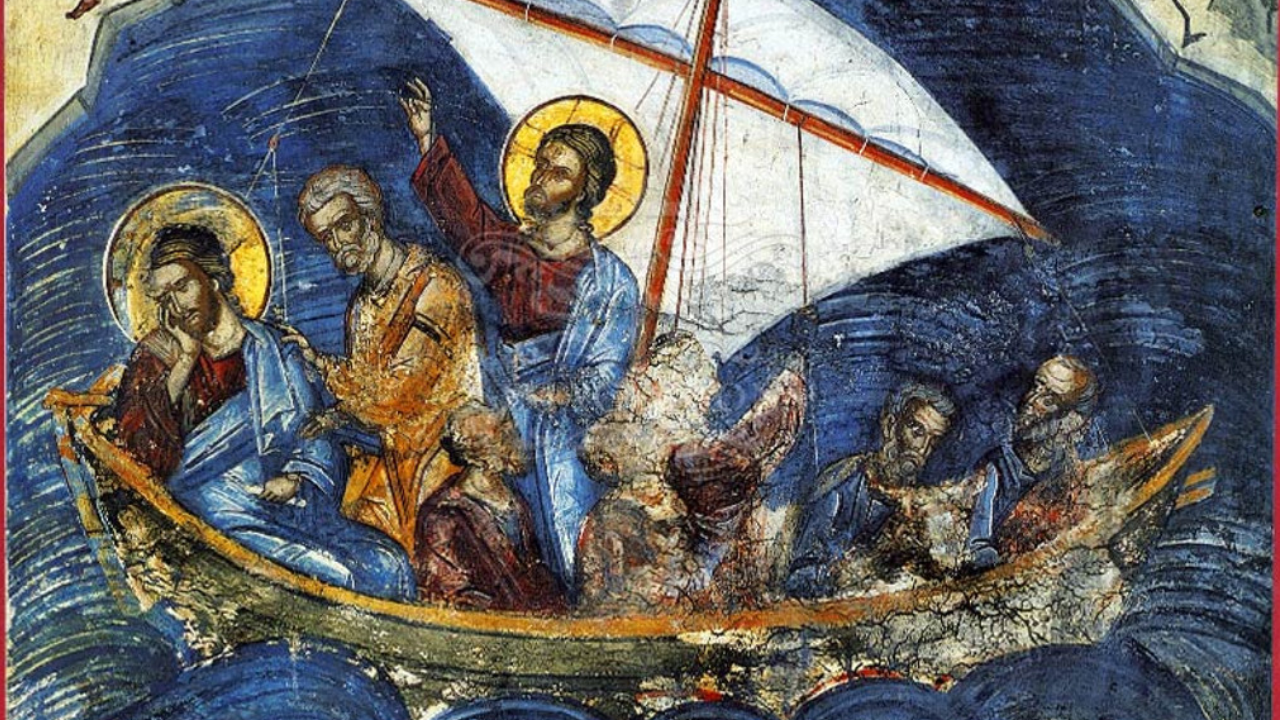
When Christ got into the boat, the text says, the weather made bold to stir up a great storm. “He got into a boat, and his disciples followed Him. And behold, there arose a great storm on the sea, so that the boat was covered by the waves: but He was asleep.” The sea had offered its heaving back for Christ to walk upon it. Now it leveled its crests to a plain, checked its swelling, and bound up its billows. It provided rocklike firmness, and He would walk across a waterway (cf. Mk. 6:48-52).
Why did the sea heave so, and toss and pitch, even endangering its Creator? Why did Christ Himself, who knows all the future, seem so unaware of the present that He gave no thought to the onrushing storm, the moment of its height, and the time of peril? But, while all the rest were awake, He alone was fast asleep—even then when utter doom threatened Himself and His dear ones. Why all this?
Brethren, it is not a calm sky but a storm which proves a pilot’s skill. When the breeze is mild, the poorest sailor manages the ship, but in the cross winds of a tempest men want the best pilot with all his skill. The disciples’ efforts as seamen, as they saw, had failed. The seas were trying to spend their fury against them, and the waves to swallow them. The twisting winds had conspired against them. So they ran in fear to the very Pilot of the world, the Ruler of the Universe, the Master of the elements. They begged him to check the billows, banish the danger, save them in their despair. At length, His mere command controlled the sea, struck back the winds, stopped the whirlwinds, brought back the calm. Then the men who were crossing the sea perceived, believed, and acknowledged that He is the very Creator of everything.
But, now, let us draw forth the inner meaning of all this. When Christ embarked, in the boat of His Church, to cross the sea of the world, the blasts of the Gentiles, the whirlwinds of the Jews, the tempests of persecutors, the storm clouds of the mob, and the foggy mists of the devils all descended in fury to make one storm over all the world. The waves of kings were foaming, the billows of the mighty seethed, the rage of subjects resounded, nations swirled like whirlpools, sharp rocks of infidelity came into view, groans resounded from Christian shores, the shipwrecks of the fallen-aways were drifting about, and there was one crisis, one shipwreck of all the world. “So the disciples came to the Lord, and woke Him, saying, ‘Lord, save us! We are perishing!’ But He said to them, ‘Why are you fearful, O you of little faith?’” Thus awakened by His disciples, Christ controls the sea, that is, the world; He pacifies the earth, softens the kings, placates the mighty, calms the waves, soothes the nations, and makes the Romans Christians. In their case, too, He brings the one-time persecutors of the Christian name to live out the word of the Christian faith. Christian princes preserve this tranquility, the Church holds it, Christianity possesses it, the Gentile world admires it.
“Then He arose,” the text goes on, “and rebuked the wind and the sea, and there came a great calm.” “And the men marveled, saying, ‘what manner of man is this, that even the wind and the sea obey Him?’” The men who approach the Lord, and awake Him, and humbly beg Him to save them, are His disciples. But other men are pointed out as those who marvel that the elements so obey Christ [Peter is following Origen who believed that the men who marveled were not the disciples, but other men in the same or different ships]. They are indeed men, men of the world, who marvel that the world has thus been converted to obedience to Christ; who are astonished that their temple tops have been cast down like the swells of the waves; who see that the froth of the idols and the whirlwinds of the devils have gone away. The deep and widespread peace of the Christian name throughout the whole world makes these men utterly astonished. And truly, brethren, when Christ was in the sleep of His death, a great storm arose in the Church. But, when He arose from the dead, a great calm was given back to the Church, as has been written.
At present, Christ is asleep in us. Let us awaken Him, by a full groan from our hearts, by our voice of faith, by Christian tears, by deep-felt weeping, by apostolic shouts. Let us cry out: “Lord, save us. We are perishing!” Furthermore, this passage applies very well to our own times. As it has been written: “The north wind is a harsh wind” (cf. Prov. 25:23: “The north wind driveth away rain.” Peter is thinking of north wind as a cold wind, and alluding to barbarian infiltrations from the north.), but by name it is called the “wind at the right” which brings us such wild and bitter nations. So this harsh north wind from the right hurls itself now to the southwest, now to the south, now to the southeast. By its devastating cross winds it confounds the seas, blacks out the sky, wears down the mountains, swallows up cities, mingles provinces together, drives the whole world to one shipwreck. Consequently, the bark of Christ is now raised aloft toward the sky, now sinks into the troughs of fear. At one moment it is under the control of Christ’s strength, at another it is tossed by terror. Now its decks are awash with billows of sufferings, now it makes its way by the oar strokes of divine praises. But let us cry out, dear brethren, again and again: “Lord, save us! We are perishing!”
And, truly, brethren, if we were one, like one human body, if we believed our perishing fellow men to be parts of our very selves, then by afflicting fellow men to be parts of our very selves, then by afflicting ourselves with fasting, by the groans of our prayers, and by copious tears we would cry out unceasingly: “Lord, save us! We are perishing!” Also, we would try to aid ourselves in the persons of our brethren. We would not be looking upon this sea of our blood amid this raging warfare. Neither would we be perceiving already such enormous shipwrecks of bodies and souls. But with humble voice we would be crying out: “Lord, save us! We are perishing!”
However, no compassion, no piety, no fear, no shame whatever, or any remorse are stirring us up to sorrow. It is from God, it is from God that we are beset with evils, that we are always being lashed, that the nations wax strong, the hail falls, the mildew pays its visits, impiety flourishes, diseases stalk uncontrolled, death rages, the earth quakes. Yet, we neither tremble, nor fear, nor turn away from our sins, nor pursue the good. Avarice runs wild, ostentation goes on apace, sin brings pleasure, other men’s goods seem attractive while our own go to ruin. The scourges of God come, but our faults provoke them.
If God is just, He is indeed also merciful toward us. Brethren, let us return to the Lord, that God may return to us. Let us renounce evil, to get good in return. Let us serve the good God, that we may escape servitude to evil nations and wicked powers, through the help of our Lord and Pilot, Christ. His honor and majesty endure without end forever and ever. Amen.
Saint Peter Chrysologus: Selected Sermons and Saint Valerian: Homilies, The Fathers of the Church Vol. 17, translated by George E. Ganss (Washington, D.C.: The Catholic University of America Press, 1953), pp. 61-65. Available for purchase at Eighth Day Books.
Share this Post on Your Preferred Platform