Strange Spectacle and Great Marvel of the World: The Life of St Symeon the Stylite
by Theodoret, Bishop of Cyrrhus
Feast of the Holy Prophet Zacharias, Father of the Venerable Forerunner
Anno Domini 2020, September 5
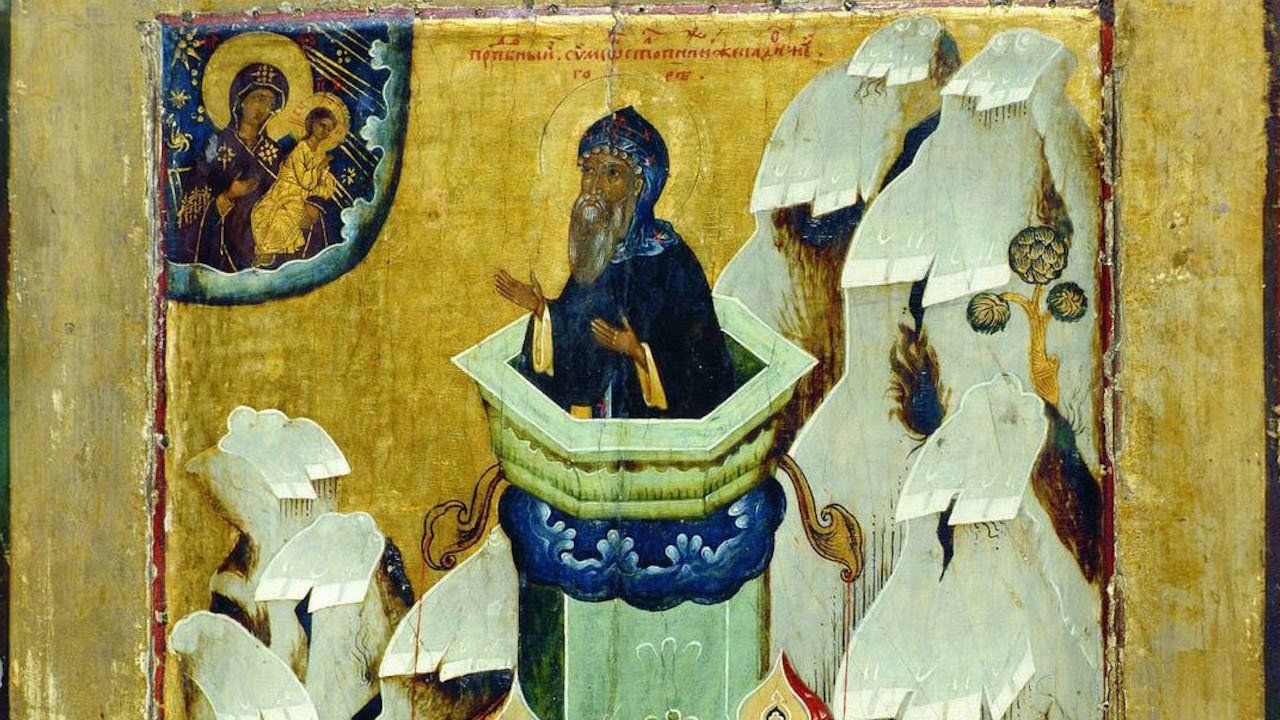
Not only all the subjects of the Roman government know the famous Symeon, the great marvel of the world, but even the Persians, the Medes, and the Ethiopians. His fame has reached the Scythian nomads and taught his love of labor and his love of wisdom. Now although I have the whole world, so to speak, as witnesses to his indescribable struggles, I feared his story might seem to those who come after like a tale wholly devoid of truth. For what took place surpasses human nature, and people are accustomed to measure what is said by the yardstick of what is natural. If something were to be said which lies outside the limits of what is natural, the narrative is considered a lie by those uninitiated in divine things. However, since the earth and sea are full of devout people who, educated in divine things and taught the gift of the all-holy Spirit, will not disbelieve what I am about to write but will surely believe, I shall write my story eagerly and confidently. I shall begin at the time he was honored with his heavenly calling.
[…]
As his reputation spread everywhere, all hurried to him—not just those in the neighborhood, but also those who lived many days’ journey distant. Some brought those with weakened bodies, others sought health for the sick, others were entreating that they might become fathers, and what they could not receive from nature they begged to receive from him. Whenn they received it and their prayers had been heard, they joyfully returned and, by proclaiming the benefits they had obtained, they sent back many more with the same demands. As they all come from every quarter, each road is like a river: one can see collected in that spot a human sea into which rivers from all sides debouche. For it is not only inhabitants of our part of the world who pour in, but also Ishmaelites, Persians, and the Armenians subject to them, the Iberians, the Homerites, and those who live even further in the interior than these. Many came from the extreme west: Spaniards, Britons, and the Gauls who dwell between them. It is superfluous to speak of Italy, for they say that he became so well-known in the great city of Rome that small portraits of him were set up on a column at the entrances of every shop to bring through that some protection and security to them.
As the visitors came in increasing numbers and they all tried to touch him and gain some blessing from those skin garments, he thought at first that this excess of honor was out of place, but then he found it annoying and tedious and therefore devised the standing on a column. First he had one hewn of six cubits (9 ft), then one of twelve (18 ft), after that one of twenty-two (33 ft), and now one of thirty six (54 ft), for he longs to soar to heaven and leave this earthly sojourn. I myself cannot accept that his standing occurred without divine dispensation. So I appeal to fault-finders to bridle their tongues and not allow them to wag at will, but to consider how frequently the Master has contrived such things for the good of the indifferent. He ordered Isaiah to walk naked and without shoes (Is. 20:2); Jeremiah to put a girdle round his loins and in this way pronounce his prophecy to the unbelieving, and at another time to place a wooden collar round his neck and later on an iron one (Jer. 13:1, 27:2, 28:13); Hosea to marry a prostitute and again to love an adulterous woman of evil life (Hos. 1:2, 3:1); Ezekiel to lie down on his right side for forty days and one hundred and fifty on his left, to dig through a wall and flee, portraying in himself the captivity, and another time to sharpen a sword to a point, shave his head with it, and divide the hair four ways and assign a part here, a part there, without listing it all (Ez. 4:4-6, 12:4-5, 5:1-4). The Ruler of the universe ordered each of these things to be done so that by the strangeness of the spectacle He might gather those who would not be persuaded by speech nor give an ear to prophecy and so dispose them to hear the divine oracles. For who would not be amazed to see a man of God walking about naked? Who would not have wanted to learn the reason for the phenomenon? Who would not have asked why the prophet dared to cohabit with a prostitute? So, just as the God of the universe providentially ordered each one of those done for the good of those living carelessly, so He arranged this extraordinary novelty to draw everyone by its strangeness to the spectacle and make the proffered counsel persuasive to those who come. For the novelty of the spectacle is a reliable guarantee of the instruction, and whoever comes to the spectacle departs instructed in divine affairs. Just as those whose lot it is to rule people change the patterns on the coins after a certain period of time, sometimes imprinting the forms of lions, sometimes of stars and of divine messengers, at other times trying to make the gold appear more valuable by an unusual coin-type, so too the sovereign of the universe puts like coin-types these new and manifold modes of life onto piety and moves to praise the tongues not only of those brought up in the faith but also of those laboring under disbelief.
Words do not testify that these things have this character, but the facts themselves shout it out. For it was the standing on the column which enlightened the many myriads of Ishmaelites enslaved in the deep darkness of impiety. Because this brilliant lamp, as if placed on a lamp-stand, sent off rays in every direction, like the sun. One could see, as I said, Iberians, Armenians, and Persians coming to gain the benefit of divine baptism. The Ishmaelites, who came in bands of two or three hundred at a time, sometimes even of a thousand, with a shout repudiate their ancestral error; they smash in front of that great luminary the idols revered by them and renounce the orgies of Aphrodite—for originally they had adopted the worship of this demon. They partake of the divine mysteries, accepting laws from his sacred mouth and saying farewell to their ancestral customs, as they refuse to eat wild asses and camels.
I myself was an eye-witness of these events and I have heard them renouncing their ancestral impiety and consenting to the gospel teaching.
*Excerpted from "The Life of Saint Simeon Stylites" by Theodoret Bishop of Cyrrhus in The Lives of Simeon Stylites, translated with an introduction by Robert Doran (Cistercian Publications, 1992), pp. 69, 74-77.
Share this Post on Your Preferred Platform
"What is it that has ordered the things of heaven and those of earth, the things which move through the air and those which move in the water; nay, rather the things which proceeded them: heaven and earth and the natures of fire and water? What is it that combined and arranged them...set them into motion and put them on their unceasing and unhindered course?..But who is the architect of these things? Or did not he who made them also bring them into being? We shall certainly not attribute such power to spontaneity." On the Orthodox Faith, Chapter 3 This comes after St. John of Damascus sets out to delineate between the created and the uncreated, a fact which, while at the core of existence, seems for him to be, for this very reason, the simplest to believe. Everything but God is created and, thus, susceptible to change. This means people, but this also means demons, angels, the rest of the created order across the entire cosmos. Everything is vulnerable to unrest. Except for God. If you have ever tried to explain the Holy Trinity to a child for the first time, maybe you have felt as I have the weightier, inexpressible side of God's unchangeability: how do I possibly communicate this essential fact to the person in front of me? (This is usually when my faint stutter starts to pop up again.) I like that here, like St. Patrick reaching for a three-leaf clover, St. John brings us back to earth to better understand the cosmos. Fire and water are no less mysteries than heaven and earth. And yet here we are, cooking and washing, eating and drinking, filled and sustained on what we can neither fully explain nor claim to have created. Only God is unchanging. Vice versa, God is the only constant we need. Maybe the rest is better left unsaid. LUKE TAYLOR GILSTRAP is Vice President of the Board of Directors for Eighth Day Institute. His poems have appeared in Spiritus, Ekstasis (Christianity Today), and Relief Journal, among others. He lives happily in Wichita, Kansas with his wife and three sons.

"Now, one who would speak or hear about God should know beyond any doubt that in what concerns theology and the Incarnation not all things are inexpressible and not all are capable of expression, and neither are all things unknowable nor are they all knowable. That which can be known is one thing, whereas that which can be said is another, just as it is one thing to speak and another to know. Furthermore, many of those things about God which are not clearly perceived cannot be fittingly described, so that we are obliged to express in human terms things which transcend the human order. Thus, for example, in speaking about God we attribute to Him sleep, anger, indifference, hands and feet, and the like." On the Orthodox Faith, Chapter 2 When I was studying Fiction in graduate school, one of the first methods I learned to really situate the reader in the story you were about to tell them was disorientation; if you wanted to ground them in one story, first you had pull the rug out from under their feet. So it's fitting that in the beginning of St. John Damascene's On the Orthodox Faith, before rebuilding our foundation, he first puts us squarely in limbo, seesawing back and forth between certainty and uncertainty. To paraphrase, there is no doubt (certainty) that about God some things can be expressed...but not all things (uncertainty). Some things about God are truly knowable (certainty), but some are unknowable (uncertainty). Oh, and while we're speaking about God (certainty), let's admit there's a gap, too, between what we say and what we know (uncertainty). My favorite line in this spiraling excerpt, "...it is one thing to speak, and another to know," takes me back to the final lines in Wendell Berry's poem, "How to Be a Poet," which he wrote primarily as a reminder to himself: Accept what comes from silence. Make the best you can of it. Of the little words that come out of the silence, like prayers prayed back to the one who prays, make a poem that does not disturb the silence from which it came. Wherever your preferences fall on the cataphatic or apophatic spectrum of theology (whether you lean more toward what we can say about God or what we cannot), Berry's poem, I think, would nod along with St. John: before we say too much, let our words be preserved by the silence from which they came. I'm thinking of the silence, that filling, restorative quiet I feel when I step into a cathedral or in some of my favorite moments with my kids in the early hours. Even before praying, can we hear the One already praying in us? Let's start there. LUKE TAYLOR GILSTRAP is Vice President of the Board of Directors for Eighth Day Institute. His poems have appeared in Spiritus, Ekstasis (Christianity Today), and Relief Journal, among others. He lives happily in Wichita, Kansas with his wife and three sons.
Late-Night Bookstores and Spiritual Reading
On St. Benedict and the Making of Vows

The Pursuit of Truth in the Age of AI

On the Theology of Raising Chickens

G.K. Chesterton and Raising Small Children

"Seal of the Fathers"

In Memory of Warren Farha, 1955-2026
An Ode to St. Brendan the Voyager