St Photius, Old Books, and Reading the Old Testament with the Church Fathers
by Erin Doom
Feast of the Holy Martyr Agatha of Palermo in Sicily
Anno Domini 2021, Feburary 5
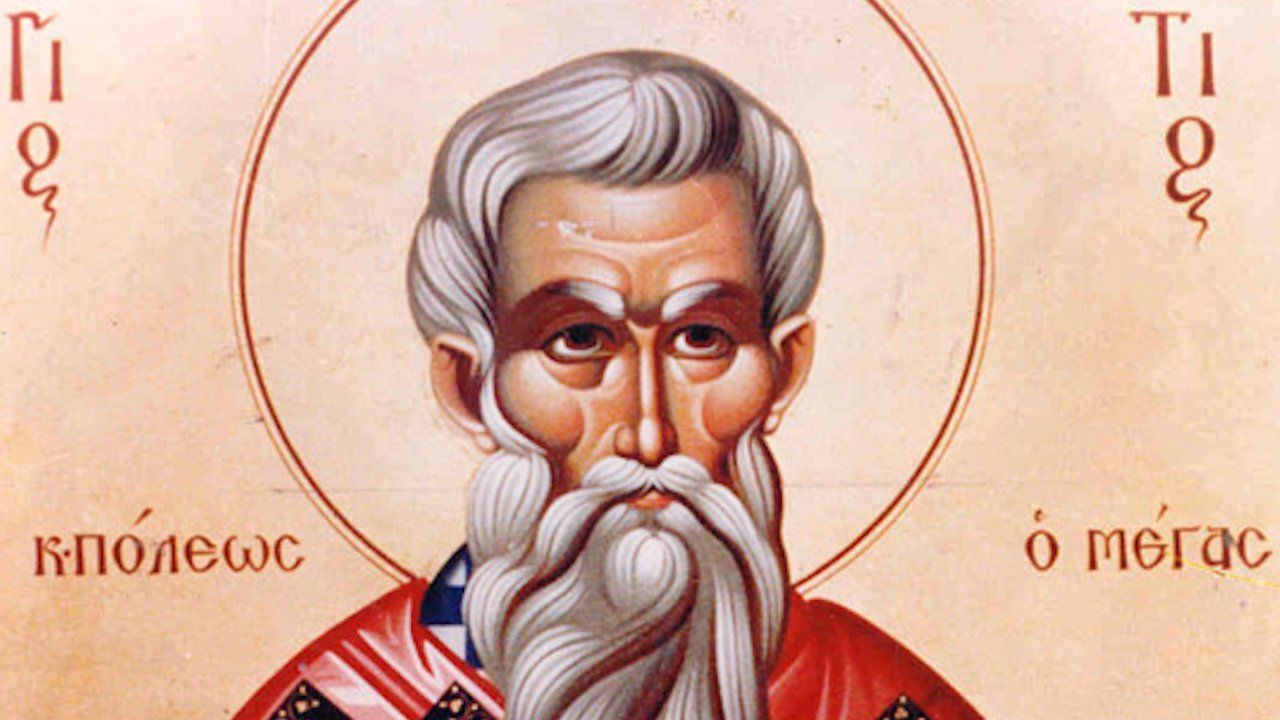
St Photios the Great, Patriarch of Constantinople (d. A.D. 891, February 6)
1. Bible & Fathers: “Have You Preserved Your Bridal Condition Unsoiled?” by St Photius the Great
Mark 10:24-32: The Lord said to His disciples, “How hard it will be for these who have riches to enter the kingdom of God! It is easier for a camel to go through the eye of a needle than for a rich man to enter the kingdom of God.” And they were exceedingly astonished, and said to him, “Then who can be saved?” Jesus looked at them and said, “With men it is impossible, but not with God; for all things are possible with God.” Peter began to say to him, “Lo, we have left everything and followed you.” Jesus said, “Truly, I say to you, there is no one who has left house or brothers or sisters or mother or father or children or lands, for my sake and for the gospel, who will not receive a hundredfold now in this time, houses and brothers and sisters and mothers and children and lands, with persecutions, and in the age to come eternal life. But many that are first will be last, and the last first.” And they were on the road, going up to Jerusalem, and Jesus was walking ahead of them; and they were amazed, and those who followed were afraid.
Tomorrow, February 6, will be the feast day of St Photius the Great, Patriarch of Constantinople. And since Lent is just around the corner, I’ve provided a small selection from the first of his eighteen homilies, titled “The Beginning of Lent.” Here’s a little taste:
As many of us as have been baptized into Christ have put on Christ and have become members of Christ; for we have learnt from the divine Paul's teaching that our bodies are members of Christ. What then of us? Have we preserved our bridal condition unsoiled, not letting it be polluted by any evil? Have we maintained our earnest of the future blessedness free from trafficking, not enticed by the allurements of harlot Pleasure, nay, have we repelled and spat upon the procuress Negligence by means of a temperate mind and a diligent life? Have we, mindful of the covenant which before angels and men we have pledged to God, kept it inviolate, showing ourselves by the fulfillment of our promises faithful to the commandments of which we have been deemed worthy? Have we barred all entry to the Evil one, and have we made our souls a temple of the most-holy Ghost, or rather the temple built for the most-holy Ghost
2. Books & Culture: “On the Reading of Old Books” by C. S. Lewis
This short and important piece was included as an introduction to a 1944 English translation of St. Athanasius’s famous work On the Incarnation. It was also included in our inaugural print publication of Synaxis. It’s worth reading every single year. So even if you have read it before, please consider reading it again. Here’s the opening paragraph:
There is a strange idea abroad that in every subject the ancient books should be read only by the professionals, and that the amateur should content himself with the modern books. Thus I have found as a tutor in English Literature that if the average student wants to find out something about Platonism, the very last thing he thinks of doing is to take a translation of Plato off the library shelf and read the Symposium. He would rather read some dreary modern book ten times as long, all about “isms” and influences and only once in twelve pages telling him what Plato actually said. The error is rather an amiable one, for it springs from humility. The student is half afraid to meet one of the great philosophers face to face. He feels himself inadequate and thinks he will not understand him. But if he only knew, the great man, just because of his greatness, is much more intelligible than his modern commentator. The simplest student will be able to understand, if not all, yet a very great deal of what Plato said; but hardly anyone can understand some modern books on Platonism. It has always therefore been one of my main endeavors as a teacher to persuade the young that first-hand knowledge is not only more worth acquiring than second-hand knowledge, but is usually much easier and more delightful to acquire.
3. Essays et al: "Reading the Old Testament with the Church Fathers" by Fr. Dr. Geoff Boyle
Fr. Geoff Boyle, the president of Eighth Day Institute, has a series of articles on the Church Fathers which have recently been published. The first one, “Reading the Old Testament with the Early Church Fathers,” serves as an introduction to the series and opens with lines from the Lewis piece above on reading old books. And then Boyle explains how the Church Fathers have impacted his reading of Scripture:
For the last 15 years, I’ve been enamored by the early Christian reading of Scripture. There’s a vibrancy, an excitement—it was like they saw everything differently, and oftentimes more brilliantly. Yes, I have, at times, rolled my eyes at some of the things the Early Church fathers said. But more often than not, I’m impressed by their devotion and find myself drawn into a deeply scriptural imaginary.
He continues:
The Early Church fathers can help us read the Old Testament. We’re used to seeing the Old Testament as a witness to Christ in two ways. Either we find various prophecies that directly foretell who He is and what He will do, or we read the Old Testament not on its own terms, but projecting the New Testament’s way of words onto a much older account, keeping the Old Testament from having its own voice. The first way of reading limits where we find Christ to select passages. The second seems to make the Old Testament of little value on its own terms. Reading the fathers helps us to break free from this either/or scenario and allows us to see Christ as not only the object of all the Scriptures, but also as the voice that speaks them into existence. For many of the fathers, the Bible ceases to be a left-to-right sort of book—where you move from the Old to the New; from Abraham and Moses and David, to Jesus and the apostles who followed. Instead, it’s more like a deeply soaked sponge, saturated with the grace of Christ crucified. And that’s not just the New Testament; for some of the earliest Christians, there wasn’t a “New Testament” per se. The Old Testament’s pages were so porous that Christ appeared everywhere.
If you haven't signed up for the Digital Symposium Library, you're missing out on a ton of great content!
You can see the list of 16 video presentations here.
And see below for the list of written reflections.
All you have to do is donate $50 or become a new member at any level.
Written Reflections in Digital Symposium Library
"Florilegium on Acedia in Evagrius of Pontus" by Erin Doom
"The Lord’s Prayer and Hope" by St Thomas Aquinas
"Hope" by Fr. Dumitru Staniloae
"Optimism as Ideology vs Hope as Gift" by Pope Benedict XVI
"Patience" by St. Augustine
"The Obscurity of Hope and Despair" by Josef Pieper
"Hope: Canto XXV of Paradiso" by Dante
"Friendship as a Source of Hope"
"His Rod, His Staff: Every Reason for Hope" by Anthony Esolen
"Hope Surprises God" by Charles Peguy
"The Birth of the New Adam, Our Renewal" by Fr. Calinic Berger
"Remembering to Hope: Three Christmas Stories" by Gaelan Gilbert
"Foreword to E. R. Dodd’s Pagan and Christian in an Age of Anxiety" by Henry Chadwick
"St Herman, Conception and Hope in the Age of Anxiety"
"The City of Cain and the City of Jesus" by Fr Matthew Baker
"Sales Resistance and Hope in the City of God"
Share this Post on Your Preferred Platform