Remembering to Hope: A Cure for the Post-Christmas Blues
by Erin Doom
Feast of St Melania the Younger
Anno Domini 2020, December 31
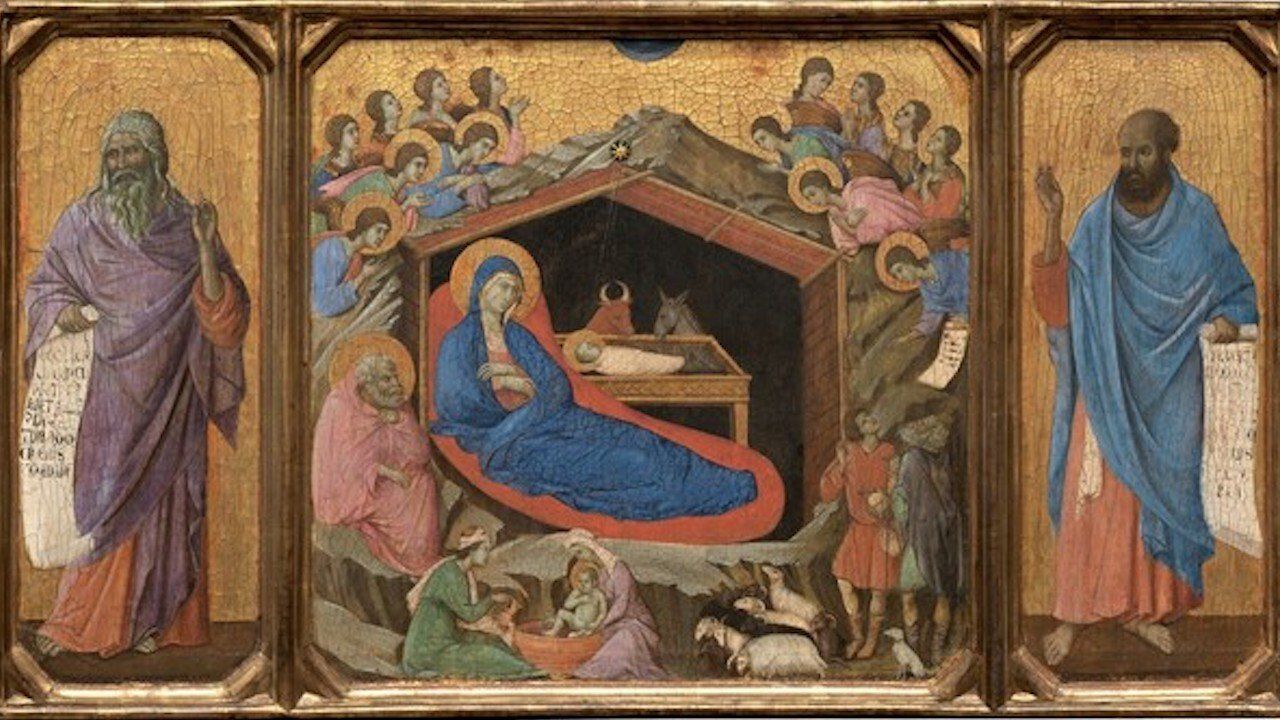
The Nativity with the Prophets Isaiah and Ezekiel, 1308-1311 by Duccio di Buoninsegna
Before diving into this week’s Microsynaxis, here’s another announcement plus three quick reminders:
- The Hall of Men has its schedule set for 2021 (the Sisters of Sophia is finalizing its schedule). Click here to see the bookmark (and the great abbreviated quote by Fr. Georges Florovsky on the great cloud of witnesses). Book marks with schedules for Hall of Men and Sisters of Sophia will be available at the Symposium. And we’re working on a gallery in the Members’ Digital Library to include all Hall of Men and Sisters of Sophia presentations.
- If you are a member and plan to attend the Nativity Feast this Saturday evening, be sure to register by 3 pm tomorrow, Jan. 1 (if you want to eat, that is).
- Information and registration for the 11th annual Symposium is now live. Learn more and register today here.
- Finally, we're still aiming for our campaign goals of 100 new members and $50,000. If you haven’t joined us yet (or renewed an expired membership), take a quick moment right now to support work toward Christian unity for the renewal of our culture. If you’ve already donated/signed up, share this email with a friend.
Now, enjoy the great content below.
In Christ,
Erin “John” Doom
1. Bible & Fathers: “The Mystery of the Incarnation Loudly Proclaimed” by St Ignatius of Antioch
Last week we celebrated the feast day of a disciple of St John the Theologian, the early second century martyr St Ignatius the God-Bearer and Bishop of Antioch. He’s one of my (admittedly many) favorite saints. If you haven’t read the epistles he wrote to various churches while he was in chains and on his way to martyrdom, you’ve got to get your hands on them (they’re included in any collection of the writings of the Apostolic Fathers and readily available at Eighth Day Books). Here is a tiny sample of an excerpt from his Epistle to the Ephesians:
Now the virginity of Mary and her giving birth were hidden from the rulers of this age, as was also the death of the Lord—three mysteries to be loudly proclaimed, yet which were accomplished in the silence of God. How, then, were they revealed to the ages? A star shone forth in heaven brighter than all the stars; its light was indescribable and its strangeness caused amazement. All the rest of the constellations, together with the sun and moon, formed a chorus around the star, yet the star itself far outshone them all, yet the star itself far outshone them all, and there was perplexity about the origin of this strange phenomenon, which was so unlike the others. Consequently all magic and every kind of spell were dissolved, the ignorance so characteristic of wickedness vanished, and the ancient kingdom was abolished when God appeared in human form to bring the newness of eternal life; and what had been prepared by God began to take effect. As a result, all things were thrown into ferment, because the abolition of death was being carried out.
2. Books & Culture: “Remembering to Hope: Three Christmas Stories” by Gaelan Gilbert
A few weeks ago I received an email from a good friend and member of the New Moot (EDI’s reading-thinking-writing group)—his physical participation has been regretfully interrupted by a move to NY for seminary at St Vladimir's (where Rod Dreher will be delivering the annual Schmemann lecture on January 30: "Living in Truth: How the Communist-Era Suffering Church Can Prepare Us to Be Dissidents"). His email to opened with the following: “Something about the Christmas season makes me all writerly.” And writerly he was. He included a wonderful reflection on three Christmas stories with an emphasis on our Symposium theme of hope. Here’s a small sample from the beginning:
I want to offer a brief reflection on three short-stories that orbit the season of Nativity and retrieve something of what is common to its atmosphere of holy celebration: memory, friendship, and hope.
The three stories are: Dylan Thomas’s A Child’s Christmas in Wales (1952); Truman Capote’s A Christmas Memory (1956), and Henry Van Dyke’s The Story of the Other Wise Man (1895).
Christmas celebrations possess a beautiful, broad variety across cultures, some of which are more well known to us than others. In Alaska, there’s “starring.” In Greece, boats start to appear in town squares for St Nicholas (the real one). Across Germany, Weihnachtsmarkts ("Holy-night markets") offer glühwein, while in France it’s
villages de noël serving
vin chaud. In American squares and main streets, evergreen wreaths adorn lamp-posts and doors, and white or colored lights outline eaves and windows. This season evinces like no other the centripetal impact of Christ’s nativity upon public space, at least in places which have an historical Christian presence.
It is similar with these stories, but in subtle ways. Two of them have the word “Christmas” in the title, but don't let that narrow your expectations; in none of them do we ever find ourselves in the lowly cave-stable, at the foot of the manger surrounded by kindly beasts and celestial choirs. Far afield, in fact. Yet the characters and events of which they tell may bring us somehow nearer to the mystery of divine incarnation, the presence of God in our midst, hidden and waiting to be found.
And as a sample of his commentary on the stories, here’s a bit from his reflection on Dylan Thomas’s A Child’s Christmas in Wales:
The story’s end casts a glance out the bedroom window of childhood, where the soft murmur of a celebratory evening lulls to sleep:
Looking through my bedroom window, out into the moonlight and the unending smoke-colored snow, I could see the lights in the windows of all the other houses on our hill and hear the music rising from them up the long, steadily falling night. I turned the gas down, I got into bed. I said some words to the close and holy darkness, and then I slept.
Such reveries of convivial community are like cool, fresh water in our desert of digital meetings and social distancing. Rather than let the disparity of our present moment bring us to despair, however, we can labor to discern ways of recuperating the essence of what Swansea embodies for Thomas, and let that recharge an impetus toward practices of hospitality, domestic celebration, and a strengthening (or healing) of familial bonds that are possible in the present. We may not need to look as far as we think. Even if we live alone, and it’s an extra effort to find “thicker” ways of connecting, it’s worth it.
Read the whole piece here. It's perfect for this season of the twelve days of Christmas. And read those stories—preferably aloud and to your family and/or friends!
3. Essays et al: “W. H. Auden’s Cure for the Post-Christmas Blues” by Jeff Reimer
Two years ago, at the Feast of the Nativity in the year of our Lord 2018, our theme was provided by W. H. Auden’s poem “For the Time Being.” Jeff Reimer—another member of the New Moot—offered a meditation on that poem and later went on to polish it up and submit for publication at Commonweal Magazine. It was published a few days ago and it is most excellent. Here are two paragraphs from early in the essay which tie Herod (in Auden’s poem) to Dostoevsky, Flannery O’Connor, and Paul Tillich:
Auden’s Herod belongs in the company of two other great literary creations: Dostoevsky’s Ivan Karamazov and Flannery O’Connor’s Misfit. All three characters understand all too well the consequences of the Incarnation, but reject its terms. Herod’s refusal to be taken in mirrors Ivan’s return of his ticket. Redemption and forgiveness, for Ivan, are too high a price to pay for the suffering of the innocent. Ivan returns his ticket because of innocent suffering, but Herod’s refusal results in it. Likewise, the Misfit despairs for lack of firsthand knowledge of Jesus’s mighty deeds, but he knows that rejection of Christ resolves not into freedom but into violence. He therefore says of Christ, “If He did what He said, then it’s nothing for you to do but throw away everything and follow Him, and if He didn’t then it’s nothing for you to do but enjoy the few minutes you got the best way you can—by killing somebody or burning down his house or doing some other meanness to him.” Herod’s refusal splits the difference between the Misfit and Ivan. In the name of humanistic compassion, Ivan rejects redemptive suffering enabled and ennobled by the Christ event; the Misfit rejects Christ but understands that the only other option is nihilism. Herod rejects the terms altogether.
In short, every character in this long and complex poem senses that the birth of the child demands a response; senses that, again in the words of the Misfit, Christ has “thrown everything off balance.” They are all caught up in the aspect of time that Tillich, developing a biblical contrast, calls kairos as opposed to kronos, categories with which Auden was consciously working. In other words, their confrontation with the Christ child is not part of the flow of ordinary chronological time, but by appointment; it is a summons, a moment of decision. In order to bring the reader to the Nativity, to gather us, too, around the child and summon us to respond, to affirm, and to submit, Auden scrambles the historical signals. Writing to his father, Auden explained that he was not trying to give “a purely historical account as one might give of the battle of Waterloo,” but was rather “trying to treat it as a religious event which eternally recurs every time it is accepted.”
Read the whole brilliant piece here.
Finally, if you’ve been encouraged, challenged, enlightened, or found any value whatsoever in my labor of love through Microsynaxis (or any of the other many EDI endeavors), please do consider supporting the work of renewing culture by joining the community of Eighth Day Members. Learn more about membership here and/or contribute to our year-end campaign here.
Share this Post on Your Preferred Platform