On the Most Venerable Dormition of our Exceedingly Pure Lady, Mother of God and Ever Virgin Mary
by St Gregory Palamas
Feast of the Dormition of our Most Holy Lady the Theotokos and Ever Virgin Mary
Anno Domini 2023, August 15
BOTH LONGING and obligation compose my homily today to your charity. It is not just my desire out of love for you and my duty under sacred laws to fill your pious ears with saving words to nourish your souls, but there is also nothing dearer or more necessary for me than to expound with due honor in church the wonders of the ever-virgin Mother of God. This longing, not single but twofold, persuades, beseeches, and encourages me, whereas inescapable duty compels me. Words, however, cannot attain to what is beyond speech, just as eyes cannot stare at the sun. But though it is impossible for us to tell of things surpassing words, we can, by the love of those we extol, sing their praises, and we may use words to pay our debt, and express our longing for the Mother of God in hymns as best we can, without in any way touching the intangible.
2. If “precious in the sight of the Lord is the death of His saints” (Ps. 116.15), and “the memory of the just is praised” (Prov. 10.7, LXX), how much more fitting is it for us to celebrate with highest honors the memory of the ever-virgin Mother of God, the Holy of Holies, through whom the saints receive their hallowing? That is exactly what we are doing today by commemorating her holy dormition and passing away, through which, having been made a little lower than the angels (cf. Ps. 8.5), she rose incomparably higher than the angels, archangels, and all the heavenly powers above them, because of her nearness to the God of all (cf. Rom. 9.5), and the marvels written of old which were accomplished in her.
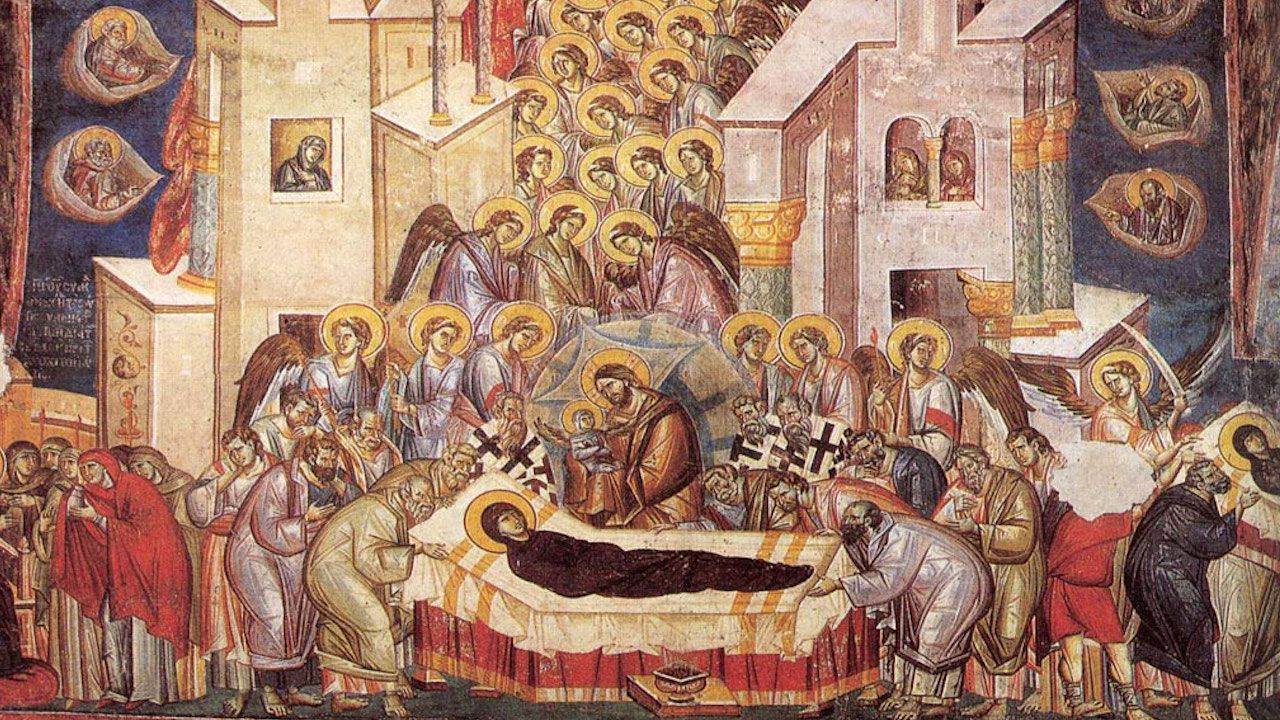
3. On her account there were divine predictions by prophets inspired by God. Miracles foreshadowed the great future wonder of the world, the ever-virgin Mother of God. Nations and circumstances were transformed to make way for the fulfilment of the new mystery concerning her. Spiritual ordinances prefigured in all sorts of ways the truth that was to be. The culmination, or rather the beginning and foundation of subsequent marvelous events, was the accomplishment of God’s promise to Joachim and Anna, the most virtuous people of their day, that, although childless from their youth, they would have a child in their extreme old age, and that their daughter would bear without seed Him whom God the Father had begotten before all ages, outside time. In addition, those who were to become parents in this mysterious way vowed to give back the child, who was to give birth herself even more mysteriously, to the giver of the gift. In accordance with this worthiest of vows, the Mother of God left her father’s house in extraordinary fashion while still an infant, to live in God’s house. For the space of many years she stayed there, strange is it seems, in the Holy of Holies, provided with indescribable nourishment by attending angels: food, which Adam never reached the point of tasting, otherwise he would not have fallen away from life; as was the case with the all-pure Virgin, who now passes from earth to heaven—even though for Adam’s sake and to show herself his daughter, she, like her Son, yielded for a short time to nature [fn: That is to say, the Mother of God also died and was raised on the third day.].
4. After this unutterable nourishment came the mysterious divine plan for the Virgin’s betrothal, the strange, inexplicable greeting of the archangel who flew down from on high, and God’s messages and salutations, which reversed Adam and Eve’s condemnation, and healed the curse which was upon them, turning it into a blessing (Lk. 1:28-38). For the King of all desired the secret beauty of the Ever-Virgin, as David foretold (cf. Ps. 45:11). He bowed the heavens and came down (Ps. 18:9), and overshadowed her (cf. Lk. 1:35), rather, the power of the Most High came to dwell in her in His very person. He did not reveal His presence through darkness and fire, as He did to Moses (cf. Ex. 19:16, 18), nor through a tempest and cloud, as He did to Elijah (cf. 1 Kgs. 18:45), but the unveiled power of the. Most High directly overshadowed the Virgin’s perfectly pure womb with nothing intervening, neither the air of earth or heaven, nor anything visible or invisible. For this was not overshadowing, but pure union.
5. Since anything that overshadows something else naturally gives it its own form and character, what came to pass in the Virgin’s womb was not just union but the formation, out of both the power of the Most High and her all-holy virgin womb, of the incarnate Word of God. The Word of God in the flesh made His abode in her, came forth from her, “and appeared on earth and went about among men.” He made our human nature divine, and bestowed on us, according to the holy apostle, “things the angels desire to look into” (1 Pet. 1:12). Such is the extraordinary honor and all-surpassing glory of the Ever-Virgin, which defeats the mind and speech of all, however angelic they may be. Again, what words can express the events that followed this indescribable birth? Co-operating with, and sharing in the sufferings of, the self-emptying of the Word of God (cf. Phil. 2:7), which was accomplished through her, and led to His exaltation, she was justly glorified and lifted up with Him, constantly adding great gifts to the extraordinary ones already bestowed upon her. Even after He who took flesh from her ascended into heaven, it was as though she was striving to emulate the great works past understanding and speech which He had wrought in her, through patient endurance in all kinds of asceticism, through prayers and exertions for the whole world, and counsels and exhortations for those going to the ends of the earth to preach. She was the sole support and consolation of all who saw or heard her, assisting by various means in the proclamation of the gospel. Thus she showed that her whole life, her behavior, her mind and her words, were utterly devoted to godly striving.
6. As a result of this, her death, too, was life-giving and led to heavenly, immortal life, and its day of remembrance is a joyful holiday and worldwide festival. Not only does it renew the memory of the wonders of the Mother of God, it also commemorates the unheard-of way in which all the holy apostles were gathered from every country to her sacred funeral, the hymns of divine revelation sung on that occasion by these inspired men, the attendance of angels, singing and ministering around her. They escorted her and followed behind, they aided or opposed, protected and defended, and with all their might assisted in deed and song, those who in any way reverenced that body which had held God and is the starting-point of life, the saving remedy of our human race, solemnly chosen from the whole creation. On the other hand, they secretly fought and opposed the Jews when they insulted her and rebelled against God in thought and deed. The Lord of Hosts, meanwhile, the Son of the Ever-Virgin, was invisibly present, honoring His Mother’s departure. Into His hands she entrusted her God-bearing spirit, and through Him her body, her spirit’s companion, was soon translated into a heavenly place of eternal life, as rightly befits her whole life from the very beginning.
7. In ancient times there were many who attained to divine favor, glory, and power. As David says, “How precious also are thy friends unto me, O God! How great is their authority! If I should count them, they are more in number than the sand” (Ps. 139:17-18 Lxx). According to Solomon, “Many have acquired riches, and many daughters have acted with power, but she excels and outdoes them all,” to an expression of degree (cf. Prov. 31:29). Standing between God and the whole human race, she alone made God a son of man, and men sons of God, rendered the earth heaven and made mankind divine. She alone among women was declared the Mother of God by nature transcending every nature. Through her unutterable childbearing she became Queen of all creation in this world and beyond, and through herself she raised up those below her, and made her subjects heavenly instead of earthly. She shared in the noblest honor, the most sublime power and the ordination bestowed from heaven through the divine Spirit (cf. Acts 1:14; 2:1-4), and was set high above all, the supremely blessed Queen of a blessed race.
8. Today she has moved from earth to heaven, and now has heaven too as a fitting dwelling-place, a palace meet for her. She has stood on the right hand of the King of all, clothed in vesture wrought with gold, and arrayed in divers colors, as the psalmist and prophet says of her (cf. Ps. 45:9 Lxx); and you should take this garment interwoven with gold to mean her divinely radiant body, adorned with every type of virtue. For at present she is the only one who has a place in heaven with her divinely glorified body in the company of her Son. Earth, the grave and death could not ultimately detain her life-giving body, which has held God and been a more beloved habitation for Him than heaven and the heaven of heavens. For if a soul which has the grace of God dwelling within it goes up to heaven when released from this world, as we believe and is evident on many accounts, how can that body which not only received within it the pre-eternal, only-begotten Son of God, the ever-flowing fount of grace, but was also plainly seen to bear Him, fail to be taken up from earth to heaven? Could she who, when only three years old, before the heavenly child had dwelt within her and been clothed by her in flesh, lived in the Holy of Holies, and who became excellent and truly heavenly even in her body through many great works, afterwards become earth subject to corruption? How could this seem reasonable to people who take a rational view?
9. It was right, therefore, that the body which brought forth the Son should be glorified with Him in divine glory, and that the ark of Christ’s holiness should arise with Him who rose on the third day, as the prophet sang (cf. Ps. 132:8 Lxx). The linen cloths and winding-sheets left behind in the tomb, which were all that those who came to look for her found there, proved to the disciples that she too had risen from the dead, just as was earlier the case with her Son and Lord (cf. Lk. 24:12; Jn. 20:5-7). It was not, however, necessary for her, as it was for her Son and God, to stay for a while longer on earth, so she was taken up directly from the grave to the heavenly realm, whence she sends bright shafts of holy light and grace down to earth, illuminating all the space around the world, and is venerated, admired, and hymned by all the faithful.
*St Gregory Palamas, The Homilies, edited and translated by Christopher Veniamin (Essex, England: Mount Thabor Publishing, 2009), pp. 289-293. Available for purchase at Eighth Day Books.
Share this Post on Your Preferred Platform