On Staretz Silouan
by Fr Georges Florovsky
Feast of the Holy Monk Martyr Anastasius the Persian
Anno Domini 2021, January 22
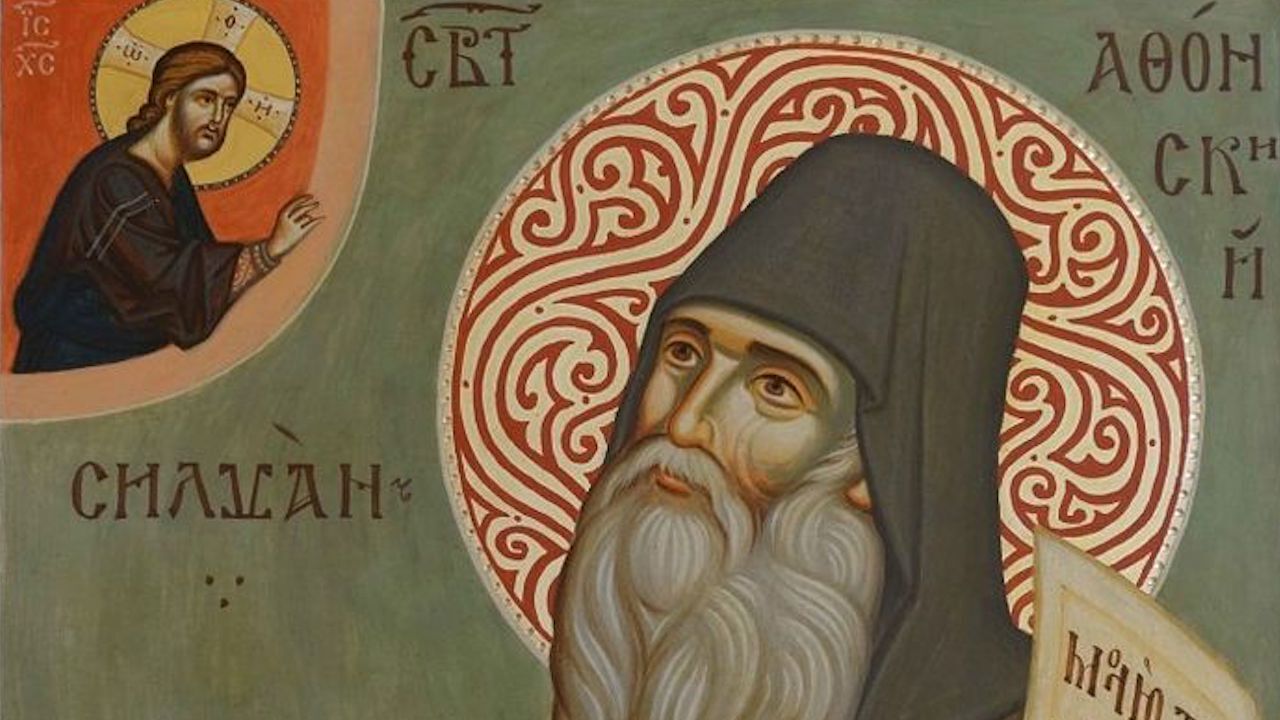
St. Silouan the Athonite - d. A.D. 1938, 24 September
Father Silouan was a humble man. But his teaching was daring. It was not a daring of the inquisitive mind, engaged in speculative scrutiny and argument. It was a daring of spiritual assurance. For, in the words of the Father himself, “the perfect never say anything of themselves, they only say what the Spirit gives them to say.” Father Silouan, surely, must be counted among the perfect. Now, this “perfection” is the fruit of humility. It can be acquired—and, what is no less important, kept and preserved—only by a constant and continuous effort of self-humbling and self-denial. This process of self-abnegation, however, is not just a negative endeavor. It is not just a denial, a subtraction, or a reduction of the self. On the contrary, it is a recovery of the true self. The process is initiated by faith and love. One denies one’s own self for Christ’s sake because of the great love for Him. The process is guided by a positive purpose. The objective is always constructive. It is “the acquiring of the Holy Spirit,” as St. Seraphim of Sarov used to say. There is here, indeed, a paradoxical tension. The purpose of the spiritual quest is high and ambitious: consortium divinae naturae, “a participation in the Divine nature” (2 Peter 1:4). In whatever manner this startling phrase of the Scripture may be interpreted, it points out, clearly and distinctly, to the ultimate goal of all Christian existence: “life everlasting,” life “in Christ,” “fellowship of the Holy Ghost.” The Greek Fathers used even the daring expression: theosis, “divinization.” Yet, the method, i.e., precisely “the way,” by which this goal can be attained, is the method of radical self-renunciation. Grace is given only to the humble and the meek. Moreover, humility itself is never a human achievement. It is always the gift of God, granted freely, gratia gratis data. The whole structure of spiritual life is indeed paradoxical. The riches of the Kingdom are given only to the poor. And with the riches authority is also given. The humble do not say anything of their own. Yet, they speak, with authority, whenever they are moved to speak at all. They do not claim any authority for themselves. But they claim authority for that which has been disclosed, through their mediation, from above. Otherwise they would keep silence. “But you have an anointing from the Holy One and you know all things (1 John 2:20).
The sayings of Father Silouan are simple. There is nothing spectacular in them, except indeed their simplicity itself. He had no special “revelations” to disclose. He spoke usually about common things. Yet even about the common things he spoke in a very uncommon manner. He spoke out of his intimate experience. Love is both the starting point and the core of Christian endeavour. But the “novelty” of the Christian Love is so often overlooked and disregarded. According to Christ Himself, the only true Love is “love for enemies.” It is in no case just a super-rogatory advice, and not just a free option. It is rather the first criterium, and the distinctive mark, of the genuine Love. St. Paul was also quite emphatical at this point. God loved us while we were His enemies. The Cross itself is the perennial symbol and sign of that Love. Now, Christians must share in that redemptive Love of their Lord. Otherwise they cannot “abide in His Love.” Father Silouan not only spoke of Love. He practised it. In a humble, and yet daring, manner he devoted his life to the prayer for enemies, for the perishing and alienated world. This prayer is a dangerous and ambiguous endeavour, unless it is offered in utter humility. One can easily become conscious of his love, and then it is corroded and infected by vanity and pride. One cannot love purely, except with the love of Christ Himself, infused and operating in the humble heart. One cannot be a “saint,” except one knows that he is himself but a “miserable sinner,” in the utter need of help and forgiveness. And yet the Grace of God washes away all stain and heals all infirmity. The glory of the Saints is manifested in their humility, just as the glory of the Only Begotten has been manifested in the utter humiliation of His earthly life. Love itself has been crucified in the world.
In his spiritual ascent Father Silouan went through the saddening experience of the “dark night,” of utter loneliness and abandonment. And yet there was nothing grim or morbid in him. He was always calm and quiet, always radiant with joy. As we learn from the story of his life, this joy has been acquired by a long and exacting contest, by an unceasing “invisible warfare.” Left alone, man is left to despair and desolation. Salvation is only in the Lord. The soul must cling to Him. Man is never left alone, except he chooses himself to leave God. Father Silouan knew by experience the dread and dangers of the outer darkness. But he also learned by experience the immensity of the Divine Love. It shines even over the abyss of trials, torments, and tribulation. Precisely because God is Love.
Father Silouan stands in a long and venerable tradition. Nor was he alone even in his own time. There was in every generation a cloud of witnesses to the Mysteries of the Kingdom. Our predicament is in that we do not know them, nor do we care for them and for their witness. We are overtaken by worldly cares. The story of Father Silouan is a timely reminder for our generation of that only “good thing,” which is never taken away. It is also an invitation to the pilgrimage of faith and hope.
Georges Florovsky
Harvard Divinity School
*Foreword to Archimandrite Sophrony, The Undistorted Image: Staretz Silouan – 1866-1938, translated by Rosemary Edmonds (London: The Faith Press, 1958), pp. 5-6. The Undistorted Image has been republished as The Monk of Mount Athos: Staretz Silouan 1866-1938 (unfortunately without Florovsky's Foreword) and is available for purchase at Eighth Day Books, along with its companion volume Wisdom from Mount Athos: The Writings of Staretz Silouan.
Share this Post on Your Preferred Platform