Director's Desk & Challenge
Birmingham, Confessions of a Heretic, Scrutopia & the Inklings
by Erin Doom
Feast of St. Chariton the Confessor
Anno Domini 2019, September 28
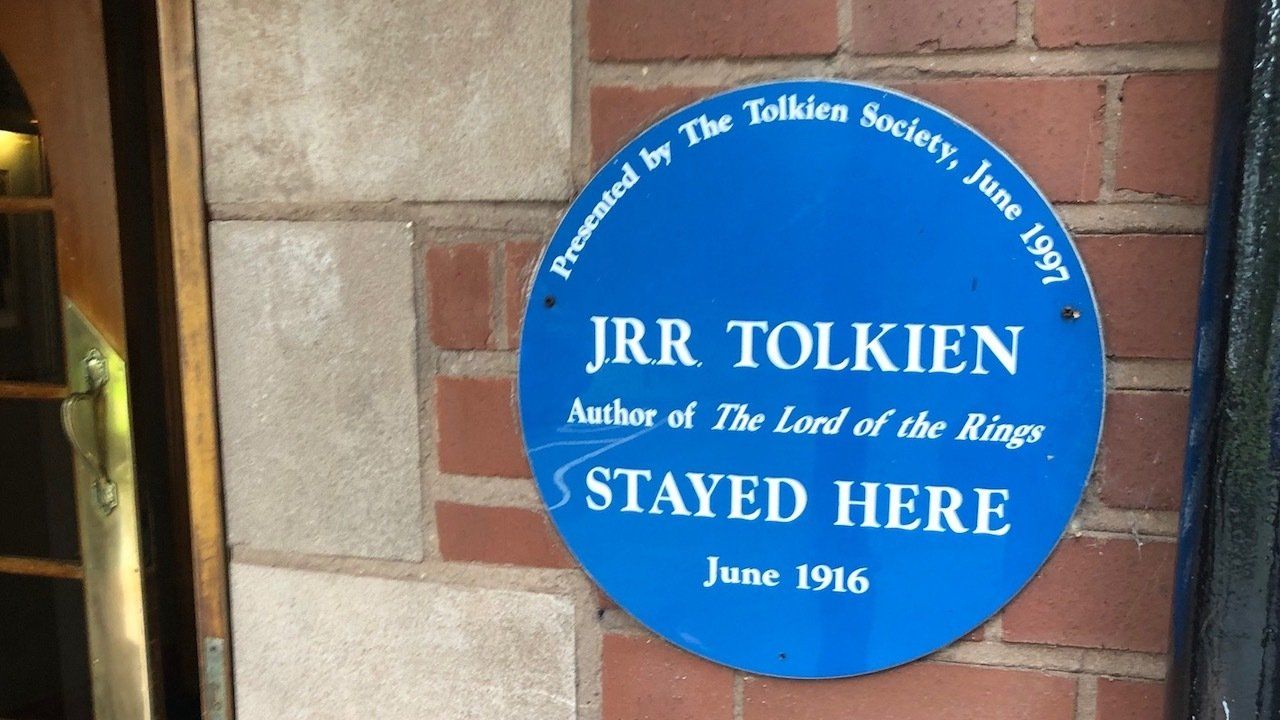
Photo of entrance to the Plough and Harrow Hotel
AFTER CANCELED flights due to storms in Chicago and over 24 hours of travel, I finally landed in London. After navigating my way onto the London Tube, I caught my first views of London and then boarded a train to arrive in Birmingham on the early afternoon of July 30. I checked into the Plough and Harrow Hotel, an 18th century house turned hotel whose claim to fame is displayed prominently at the entrance: “J. R. R. Tolkien, author of The Lord of the Rings , Stayed Here June 1916.”
After dropping my luggage off in my room, I immediately began wandering the streets, as is my custom when I’m in a new city. Unfortunately, my wandering this time happened to be on a rainy day. So by the time I found a pub to read in, I was cold and drenched. But a pint and a pen with a good book always redeems a rainy day (even when drenched to the bones, as I learned on this occasion).
This trip to England was sheer gift. It was made possible by an Eighth Day Member. A few weeks after our ninth annual Eighth Day Symposium (“Eros & the Mystery of God: On the Body, Sex & Asceticism”), a supporter contacted me with an admonition to attend Scrutopia, a summer school that offers a ten-day immersion experience in the philosophy and outlook of Sir Roger Scruton (a British writer and philosopher who specializes in aesthetics, political philosophy, and traditional conservatism). But it wasn’t just an admonition. Convinced that cross fertilization between Eighth Day Institute and Scrutopia would be beneficial to both parties, it was a generous offer to cover travel and tuition expenses.
I have to confess that although I knew who Roger Scruton was, primarily from my time working at Eighth Day Books, I had never read him. When Eighth Day folks learned I was attending Scrutopia, which was confirmed (and announced) right before the controversy erupted over Scruton’s interview with the New Statesman (this initially led to Scruton being dismissed as chairman of the Building Better, Building Beautiful commission, but ultimately led to an apology from the New Statesman for tweets that misrepresented Scruton’s views), people began sending me controversy-related pieces by Scruton and others. I took a cursory glance at those materials and was intrigued. And I purchased some of his books in preparation for the trip, which I also took cursory glimpses into. But I didn’t really read Scruton until this first day in England, when I serendipitously landed in The Craven Arms, a pub built for Holder’s Brewery back in the early twentieth century.
Over a dark ale, and then a cider for my friend Shailesh, I finally dug into Scruton. I began with a small collection of essays which Scruton describes as the fruit of a decade of his “engagement with the public culture of Britain and America”: Confessions of a Heretic: Selected Essays. I read the entire book in one sitting. And I was not disappointed. I understood why an Eighth Day Member would want me to attend Scrutopia. Our interests and concerns are indeed similar. As I read, I felt like I already knew Scruton.
The wide range of his interests can be seen in the table of contents:
1. Faking It (as a teaser, click here for the conclusion of this chapter on beauty, form, and redemption as the sources of art with real and lasting appeal)
2. Loving Animals
3. Governing Rightly
4. Dancing Properly
5. Building to Last
6. Effing the Ineffable
7. Hiding behind the Screen
8. Mourning our Losses: Reflections on Strauss’s Metamorphosen
9. Branding the Bottle
10. Dying in Time
11. Conserving Nature
12. Defending the West
If Eighth Day Institute were to ever organize a pilgrimage to England, it would include a visit to Scrutopia. And it would require the reading of this book as an introduction to the work of Sir Roger Scruton. If any of you have any interest in such a venture, let me know. The doors are open at Scrutopia…I have already confirmed that.
After finally reading Scruton, and a bonus morning mass at the Birmingham Oratory (an English Catholic religious community founded by Blessed John Henry Newman; this is another story to be told in a future piece…OK, I’m going to have to make this post the first in a series reflecting on England, Scruton, et al), I boarded another train to make my way to Scrutopia at the Royal Agricultural University in Cirencester. I spent ten days there, occupied in the mornings with lectures on the philosophy and literature of Sir Roger Scruton, and then in the afternoon taking group excursions to pre-historic (Stonehenge), ancient (Roman villas), and medieval (cathedrals) sites. In the evenings, in good Eighth Day style, new friendships were forged over food and wine. In the next Director’s Desk I’ll tell you more about those ten days and the important work of Sir Roger Scruton.
In the meantime, and in conclusion, as we move into October and begin to think about our fifth annual Inklings Oktoberfest, your October challenge is three-fold:
1. Read something by an Inkling, preferably an entire book, but at least one chapter or a story or poem.
2. Share your favorite quote or passage on our EDI Facebook page (I’ll make a post inviting folks to share) or email it directly to me and I’ll post it for you.
3. Read the conclusion to Sir Roger Scruton's essay "Faking It" in his Confessions of a Heretic and consider purchasing a copy from Eighth Day Books.
Erin Doom is the founder and director of Eighth Day Institute. He lives in Wichita, KS with his wife Christiane and their four children, Caleb Michael, Hannah Elizabeth, Elijah Blaise, and Esther Ruth.
Share this Post on Your Preferred Platform