Enjoyment of Christmas
by Kathleen Bliss
Feast of St Melania the Younger, Nun of Rome
Anno Domini 2021, December 31
The Supplement to this News-Letter is a long one, and to some of our readers the subject may seem an unusual choice for a Christmas number, since it is not customary to talk about the suffering of humanity at a time when most people are thinking, or trying to think, of gifts and gaiety.
There are many inner frames of mind in which to celebrate Christmas. One is to make it a time of make-believe, when for a moment we forget what the world is like and enjoy ourselves after our own fashion. If we are religious we can heighten the enjoyment of getting out of the everyday world for a bit by using the Christmas story and its traditional re-telling in song and worship to transport us to a Bethlehem long ago, where the star shines down and shepherds see a vision of angels and wise men bring gifts. It is some sort of a compensation for the lack of any guiding star or any vision of angels on our daily path through the world if for a few days we can contrive to re-live these things in the imagination. The other way of celebrating Christmas is, instead of allowing ourselves wholly to be carried back two thousand years, somehow to experience an Incarnation brought onwards two thousand years into this present world so filled with sorrow and foreboding.
Perhaps it will be thought that in our view the good Christian should never cease from thinking about the miseries of the world and should take even his pleasures as gloomily as he can. That is far from what we mean. If we could never escape, never read detective novels, never give ourselves up to the pleasures of idleness or to sheer enjoyment, we should end up not good but mad. God has made a world where there are almost inconceivable possibilities of suffering, dread, and all-pervading death, and has spangled it all over with objects and experiences of sheer delight. But the world has taken Christmas and has made it a time for suspending everyday experience. Yes, it will even accept visions and angels and stars and shepherds and wise men as part of the paraphernalia, with their nostalgic reminders of a lost age of faith. What is truly affronting to the mind which has lost faith is not so much a suggestion that years ago learned sages and astrologers saw a star and worshipped a Child, but the suggestion that perhaps a scientist in his work might become aware of the Dayspring from on High. Shepherds, perhaps because exceedingly few of us have ever known one personally, are for us the very archetypes of kindly care (is there a single detective novel, one wonders, in which the guilty party turns out to be a shepherd?): it is not so very unimaginable, therefore, that these faraway and unreal people should see visions, but who expects their successors weaving wool in Bradford to be startled by the news that a Child is born? We have surrounded Christmas with escapes and jollifications, and in the process, even for some of Christians, the very central heart and core of Christmas, the over-powering mystery of God made Man and come among us, slips from our grasp and becomes—though we hardly dare acknowledge it—just one of the things we tell ourselves at Christmas time, and honestly wish we believed in more than we do. We have not celebrated Christmas, if in Church or at home we have succeeded in summoning before the eyes of our imagination the picture of the stable, the Child, the Mother, and have made ourselves there present, by an act of the imagination. It is indeed a part of the truth of the Incarnation that God became a man, became that particular baby lying in that particular manger. But He also became Man and took on our mortal flesh. He shared not only the particular experiences, in His earthly ministry, of two not very well adjusted sisters in their country home, of a ruler with a thirst for truth, of a loose-living woman by a well, but also He is, in a sense which we catch only in moments of adoration, or when some experience of life deals hardly with us, present as Man in all the sufferings of men. We worship the Jesus Who was born in Bethlehem in the days of Herod the King, but the picture is not the one of harmony and simplicity which we should like to make it. At His very birth innocent blood is shed, and the cries of a hundred stricken mothers mingle with the songs of Hallelujah. Even if we are among those who find it difficult to give the full weight of historicity to a narrative so mingled with the imagery of Old Testament prophecy, we can at least admit that this is true of life, that men make joy and slaughter out of God’s gifts.
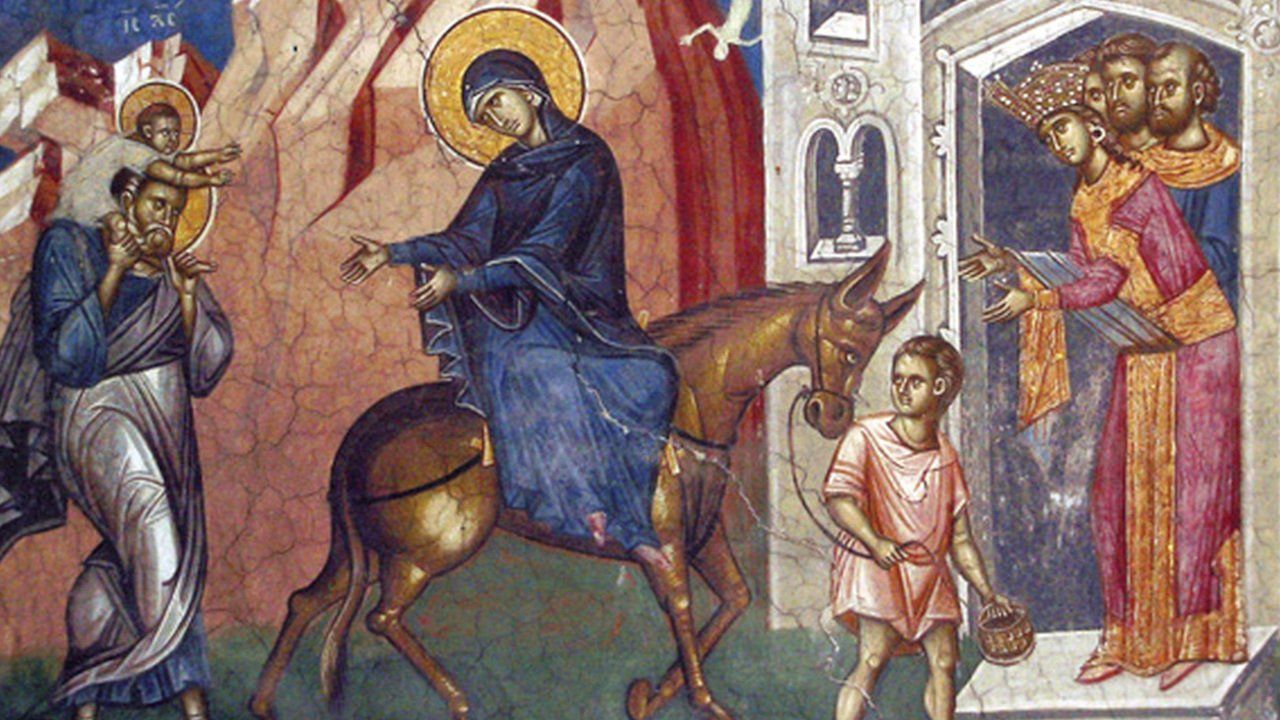
If we sit down quietly to read not just our favourite parts of the story of the birth of Jesus, but the whole of it, the simple yet strange narrative of Matthew and Luke, the penetration into the inner meaning of the mystery in St. John, the prophecies which place it as the culmination of a long series of thoughts, acts, and sufferings which prepared for it, then we allow the Bible to say something to us, and the Incarnation, instead of being a picture painted on its pages whose colours, true enough, will never fade, but whose figures will never move towards us however lovingly we gaze at it, becomes a movement of God to us here and now. Suddenly we hear with the cries of the innocents, the shrieks of several thousand Chinese refugees as the boat sinks under them and the waters swallow up their hope of escape for ever. The homeless family flying to a foreign land seems to gather into its sorrow and its determination the sorrows of the homeless throughout the earth. Far from the necessity of sympathizing with and reaching out a hand to the burden of sorrow which rests upon our fellow men, this drawing near of the Incarnation to us begins to give us, towards the sufferings of men, a new sensitivity.
In a remarkable novel published this year [1948], called The Plague, Albert Camus describes an imaginary outbreak of bubonic plague in the town of Oran, seen through the eyes of the town’s medical officer. Camus is a secular existentialist, and his novel shows how a group of different men and the crowd of the population at large respond to the horror of the plague’s developing fury. The doctor, assisted by the quiet presence of his old mother, plods steadily forward on his duty; a Parisian journalist caught there bends every nerve to bring about an illegal escape, and turns down the offer of a passage through the blockade when it finally comes. The central figure, whom none of his friends can place in any profession or any class, works doggedly but with a certain detachment, partaking yet observing. Just before his death he reveals to the doctor the motive spring of his life. He is overwhelmed by the thought of human suffering, and especially by the suffering that is inflicted on men by their fellows. He is determined to pit his life against this suffering. His ambition is to be a saint. But he does not believe in God: in fact, he says that if there were a God he would not feel called upon to strive against suffering or to give up his own desires, for if there were a God it would be His business to deal with this, the outstanding feature of the world He is supposed to have made. It is a novel that Christians ought to read.
There has also just come to this country from France a film which is a little masterpiece on the same theme. It is the story of St. Vincent de Paul, under the title Monsieur Vincent. Seventy-five million francs were contributed by a hundred thousand French people to finance its making. The figure of St. Vincent is human and compelling. He, too, is drawn to find his life work among the poor in a ministry to suffering. But the strength of his life comes not from his making a few thrusts and stabs against a torturing scheme of things: all he sees, all to which he ministers, is made bearable by the thought of the divine mercy on which his life is stayed. And when a comparison is made it is not the Christian saint but the secular saint who seems a little overdrawn, a little more than human, and stretches our credulity as we ask whether it is possible for a mortal man to attempt with his bare hands to push back an avalanche without growing embittered against the forces which make his task unfinishable.
*First half of The Christian News-Letter editorial by Kathleen Bliss (22 December, 1948). The second half, “The Christian Hope,” is published here.
Share this Post on Your Preferred Platform