Digital Fasting
Disconnect to Reconnect to God & Neighbor
NEW FORMS of media still called digital media, which are accessed via computers, tablets, and especially now smartphones, and whose content is mainly that of the Internet, social networks, and messages (SMS, MMS, etc.) have invaded the lives of contemporary people and especially those of today’s youth, from the age of ten and sometimes younger.
Their ability to communicate quickly and almost at no cost, the possibility they provide of accessing nearly everyone and everything, and the power of the images circulated in digital media imbue digital media with a considerable power of seduction. Social pressure (in particular the pressure to conform), but also the economic organization of society, has made these into tools one is almost obliged to have so as not to be excluded from various social, administrative, or economic groups or circles.
Mostly, however, it is a dependence of an internal or psychological nature that has been established among users of all ages. This addiction worries many parents, as it now affects many children, and it is even noted by the users themselves; we see this addiction most clearly in the most severe cases, where drastic treatment, in particular in the form of a long-term total withdrawal from such media, is required, and sometimes clinical psychiatric care as well. Yet this addiction often remains unperceived in less serious cases, since habit is capable of making what is not normal appear to be so. It should be noted: for most users, the use has become abusive.
At this conference, which has brought together actors from the Orthodox media, the media are presented in most cases in a positive way, as either belonging to the ecclesial life or as being something which ought to belong to it, with the idea that they have now become driving forces indispensable to the pastoral and missionary activity of the Church. This quasi-paradisiacal vision, however, must be tempered. In real life, people spend far less time visiting Orthodox sites than they do others, and many young Orthodox remain completely oblivious to them. In the vast majority of cases, the passions that inhabit fallen man attract him to content in conformity with these passions, whether via the choice of sites visited or via the motivations for communicating on social networks such as Facebook, where narcissism (which the Greek Church Fathers call philautia ) plays a considerable role, whether in the staging of oneself or in the frenzied quest after “likes” that flatter the ego.
I recently published a 320-page book entitled “Sick of the new media” (in French : “Malades des nouveaux médias”), which has been translated into Romanian under the title “Prisoners of the Internet,” and which is currently being translated into English under the title “Addicts of Modern Media.” In this book, I show in a very detailed and reasoned way the negative, corrosive, and destructive effects the new media have on the various spheres of human life: psychic, intellectual, cultural, social, relational, and finally (and especially) spiritual. I also propose a few preventative and therapeutic measures, especially of a spiritual nature. For this presentation, which must be very brief, I have chosen to speak only about fasting and abstinence as means for limiting and controlling the use of new media, which in most cases has become abusive and harmful.
Concerning the consumption of food and sexual activity, the Orthodox Church has established rules of limitation and abstinence for the Lenten periods as well as certain days of the week and of the year.
One of the main purposes of these rules is to accustom the mind to controlling the bodily and psychic impulses, to reorient and refocus the psycho-physiological forces towards the spiritual life, to establish a state of hunger and desire causing a person to sense their dependence on God and their need for Him, and to establish in the soul a peaceful state disposed to penitence and promoting attention and concentration in prayer.
The abuse of new media, which has become common, produces effects contrary to those sought by fasting and abstinence: the vain exhaustion of energy, permanent external solicitation and dispersion, incessant internal movement and noise, an invasive occupation of time, the impossibility of establishing or maintaining inner peace, and the destruction of the attention and concentration necessary for vigilance and prayer.
These effects, it should be stressed, are related to the use of new media once a certain threshold has been reached, regardless of their content. As the great media expert Marshall McLuhan has shown, the medium has a greater impact than the message it conveys, to the point that we can say that “the medium is the message.” This, of course, should not make us forget the question of the content, which, when it is bad, ends up inciting and nourishing the passions, further increasing the degree of incompatibility with the ascetic life broadly understood and harming even more the spiritual life.
The Church must take into account these new circumstances created by our time, and must establish appropriate rules, accompanying those of fasting from food and sexual abstinence, so as to help modern man, through regular voluntary limitation, to free himself from the new addictions that bind him, and so as to give him the means to lead in full the spiritual life befitting his nature and serving as the condition for his true personal development.
One could say that no rule is necessary for this, and that pastoral recommendations suffice; but one could say the same thing, however, with respect to fasting from food or sexual abstinence, for which the Church has established canons, and in solemn manner no less, at Ecumenical Councils, by reason of the fact that rules that formulated officially and with precision have a greater impact, have a more universal scope, and are of a more obligatory character than mere recommendations at the parish level, which moreover are not always made.
The question that arises here is that of the nature of fasting and abstinence practiced.
As mentioned above, it is a matter of limiting the amount of time one is connected and of strictly regulating the use and content of these media. It is necessary to give up being permanently connected, and to limit the connection to one defined period in the day. We need to get rid of unnecessary media, such as social media (Facebook, Instagram, Twitter, etc.) and all entertainment websites. Any websites that pose a risk of temptation or leading to bad encounters should obviously be avoided. It is also fitting to limit one’s Internet connection to what is strictly necessary for professional work or studies.
Parents need to teach their children, who use these new media, to implement such a limitation by explaining to them the meaning behind it.
The Lenten periods opportunities open to all for jettisoning the artificial and virtual relationships of social networks so as to rediscover deep, concrete, and real relationships with family and friends, and in general so as to be more attentive to the people around us. These Lenten periods are also opportunities for rediscovering silence and solitude, which are necessary for the practice and development of the spiritual life.
The question that risks provoking ire here in the context of this conference is whether the rule of fasting and abstinence from new media should be extended to Orthodox sites as well. I do not want to put most of the participants in this symposium out of a job, and my aim is even less to limit the presence of the Christian and ecclesial word in a world where it is already too little present.
But first of all, I would like to point out that during the Lenten periods, and especially Great Lent, a number of Orthodox media, especially those with spiritual content, are self-limiting: they either close their sites for a period of time of various length, or at least slow down and restrict their production.
Such a restriction has an exemplary value and testifies in its own way to the existence of Lent and the limitations to which it calls us.
My second remark concerns reading. It is true that in a very positive way, most Orthodox media offer spiritual readings at least in part, and some sites are even devoted solely to such literature. There is therefore no reason, in principle, to limit the production or consultation of such sites, and it seems that it should even be encouraged, insofar as the faithful are encouraged to do more spiritual reading during the Lenten periods.
However, I would like to point out here that the scientific studies that have been done on the methods of reading on a screen show that this type of reading is both rapid and superficial.
On screens, texts appear to us as images. For this reason, the text on a screen becomes the object of a sweeping gaze, just as in the case of an image, with one’s eye usually resting on only a few lines.
One study found that the vast majority of people do not read the text line by line, as they would in a book, but rather jump quickly from the top of the page to the bottom, in a movement generally following the shape of the letter F: they read the first lines, go down a little, read the left part of a few lines, then go down along the left side of the page.
A second study concluded that the average reader on the Internet only reads about 20% of the text.
A third study found that most web pages are viewed at most for 10 seconds, which clearly shows that they are not really being read.
Reading on a screen barely stops on words or phrases. It is a reading where there is little backtracking, and is not very reflexive. It is a superficial reading which hardly gives rise to efforts of comprehension and memorization.
In many ways, new media make the relationship to the text lighter, more unstable, more fragile, more ephemeral.
Fasting periods can and should be periods when the time for and the quality of reading can be regained by abandoning digital media in favor of printed materials, and especially books, which all studies show allow for a much more fruitful reading than do screens, while lacking the disadvantages of the latter.
Completely cutting oneself off from media of any kind during the Lenten periods is an ideal solution for finding the hesychia indispensable to the deepening of the spiritual life, which is precisely the main goal of the fasting periods.
In conclusion, I would like to note that many private clinics and hotels offer longer or shorter stays of total disconnection, starting on the low end at prices of 1000 euros, or about 1200 dollars, per week. The Orthodox Church should officially offer this possibility during the Lenten periods as a guaranteed free service, thus making it accessible to all, and moreover with a spiritual profit not found elsewhere. One of these clinics has as its advertising slogan: “Disconnect to reconnect.” The Church can make this slogan her own by specifying: “Disconnect from new media to reconnect with God and your neighbor.”
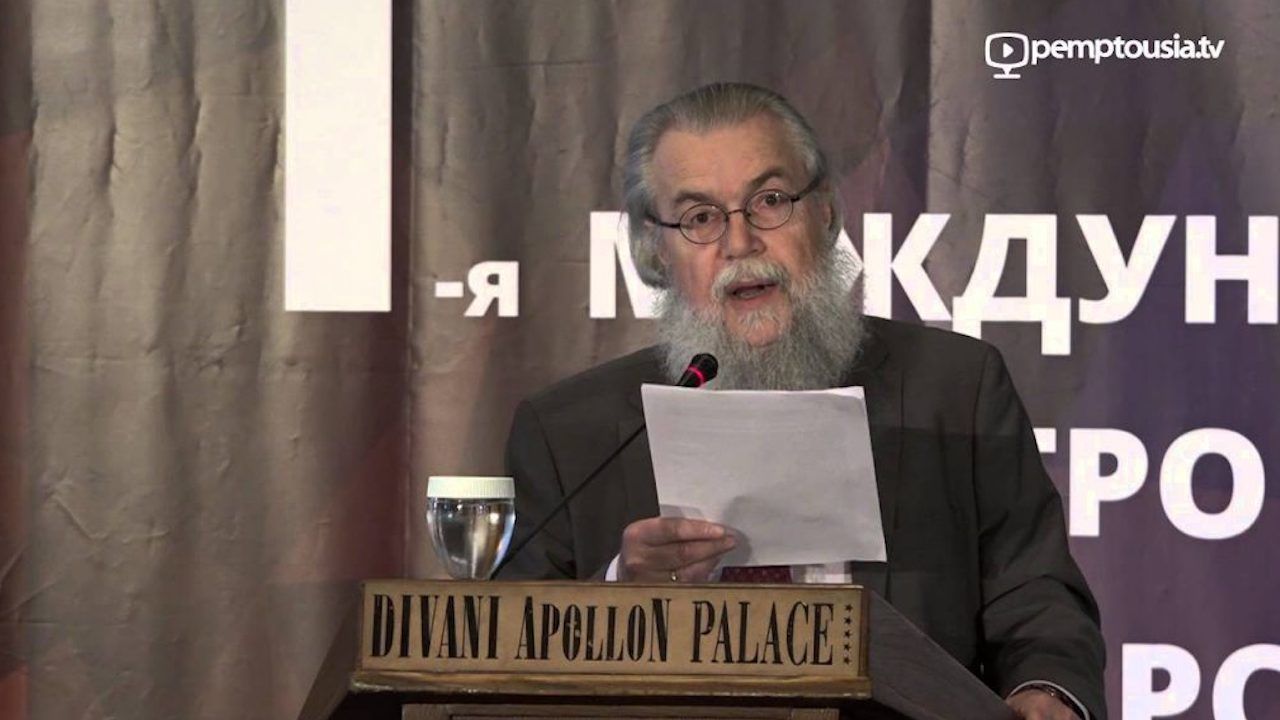
*Originally presented at the 2nd International Conference on Digital Media and Orthodox Care, 18-21 June, Anno Domini 2018
Jean-Claude Larchet is a philosopher and patrologist who is known for his examinations of patristic writings on the causes and consequences of spiritual and physical illness. He is an Honorary Professor of philosophy and theology at the National Institute of Geneva.
Share this Post on Your Preferred Platform