Alcuin of York: Letter, Poem, Epitaph
by Erin Doom
Feast of Our Righteous Father Memnonus the Wonderworker
Anno Domini 2020, May 19
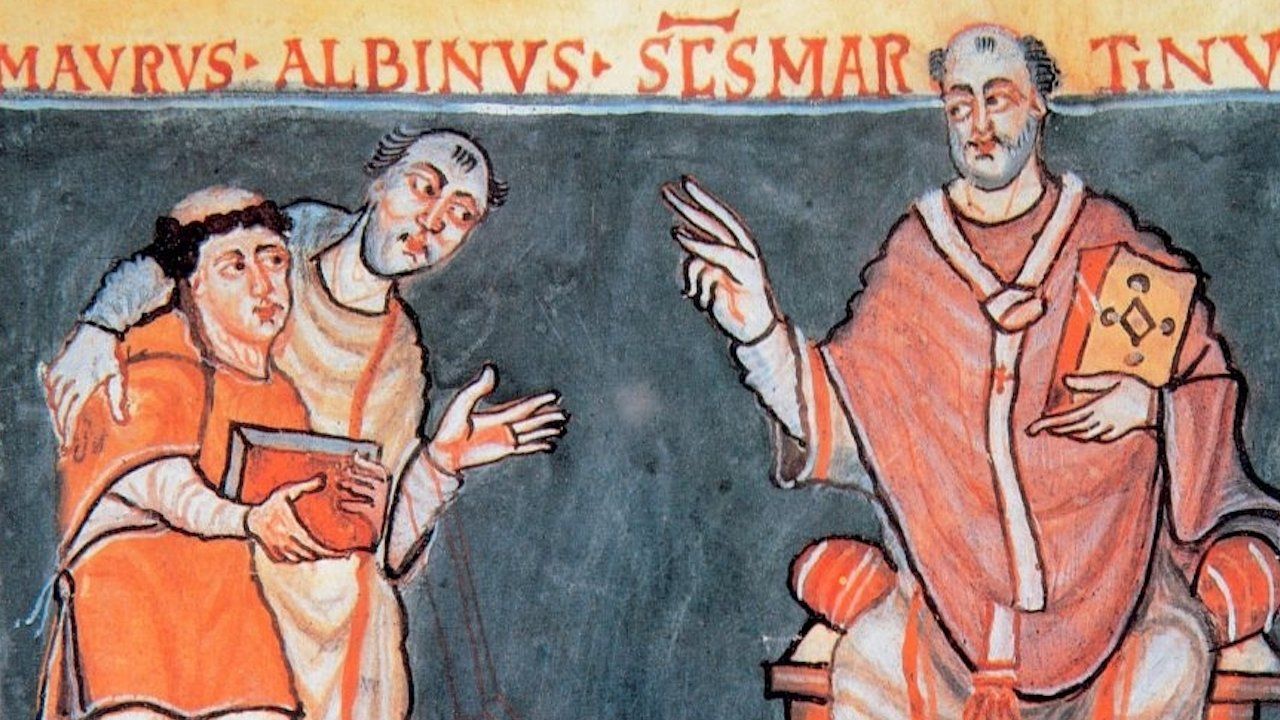
Carolingian Manuscript, Rabanus Maurus (left), with Alcuin (middle),
dedicating his work to Archbishop Odgar of Mainz (right)
1. Essays et al: “Alcuin of York: Architect of the Carolingian Renaissance”
On this day in A. D. 804, the English scholar, poet, deacon, and teacher Alcuin of York died in the monastery of Tours in Gaul. According to the Life of Charlemagne, he “was the most learned man anywhere to be found.” In 782 he was put in charge of teaching at the Palace School of Charlemagne where he helped initiate the Carolingian Renaissance. In addition to his teaching duties, as Tabea Tietz notes,
he took his role as a religious and political advisor very seriously and his ideas were highly respected by the emperor. Alcuin tackled him over his policy of forcing pagans to be baptized on pain of death, arguing, “Faith is a free act of the will, not a forced act. We must appeal to the conscience, not compel it by violence. You can force people to be baptized, but you cannot force them to believe.” These arguments seem to have prevailed, because Charlemagne decided to abolish the death penalty for paganism in 797.
Alcuin also developed a new style of handwriting, the Caroline miniscule, invented the “question mark,” and helped Charlemagne fight the Adoptionist heresy.
2. Books & Culture: A Letter & a Poem
Alcuin became Abbot of St Martin’s at Tours in 796. From there, he wrote the following words as the introduction of a letter to Charlemagne in A.D. 796:
But I, your Flaccus [Alcuin’s Latin name], am doing as you have urged and wished. To some who are beneath the roof of St. Martin I am striving to dispense the honey of Holy Scripture; others I am eager to intoxicate with the of wine of apples of grammatical refinement; and there are some whom I long to adorn with the knowledge of astronomy, as a stately house is adorned with a painted roof. I am made all things to all men that I may instruct many to the profit of God’s Holy Church and to the luster of your imperial reign.
3. Bible & Fathers: Alcuin's Epitaph
Acts 12:25; 13:1-12; Jn 8:51-59. Online here.
Alcuin was buried at St Martin’s Church under the following epitaph that he composed for himself (he also composed the famous epitaph of Pope Hadrian I):
Here halt, I pray you; make a little stay,
O wayfarer, to read what I have writ,
And know by my fate what thy fate shall be.
What thou art now, wayfarer, world-renowned,
I was; what I am now, so shall thou be.
The world’s delight I followed with a heart
Unsatisfied: ashes am I, and dust.
Wherefore bethink thee rather of thy soul
Than of thy flesh; — this dieth, that abides.
Dost thou make wide thy fields? In this small house
Peace holds me now; no greater house for thee.
Wouldst have thy body clothed in royal red?
The worm is hungry for that body’s meat.
Even as the flowers die in a cruel wind,
Even so, of flesh, shall perish all thy pride.
Now in thy turn, wayfarer, for this song
That I have made for thee, I pray you, say:
“Lord Christ, have mercy on thy servant here,”
And may no hand disturb this sepulchre,
Until the trumpet rings from heaven’s height,
“O thou that liest in the dust, arise,
The Judge of the unnumbered hosts is here!”
Alcuin was my name; learning I loved.
O thou that readest this, pray for my soul.
*If you’d like to receive the Digital Synaxis
in your inbox every Wednesday and Saturday, you can subscribe here.
**All books (and icons) in print available from Eighth Day Books. Please support an independent bookstore that believes in the eighth day resurrection of our God and Lord and Savior Jesus Christ. Give them a call at 1.800.841.2541 or visit their website here. And don’t forget Eighth Day Members (Patrons+) receive 10% discount, plus many other perks! Learn more and become a member here.
Share this Post on Your Preferred Platform
"What is it that has ordered the things of heaven and those of earth, the things which move through the air and those which move in the water; nay, rather the things which proceeded them: heaven and earth and the natures of fire and water? What is it that combined and arranged them...set them into motion and put them on their unceasing and unhindered course?..But who is the architect of these things? Or did not he who made them also bring them into being? We shall certainly not attribute such power to spontaneity." On the Orthodox Faith, Chapter 3 This comes after St. John of Damascus sets out to delineate between the created and the uncreated, a fact which, while at the core of existence, seems for him to be, for this very reason, the simplest to believe. Everything but God is created and, thus, susceptible to change. This means people, but this also means demons, angels, the rest of the created order across the entire cosmos. Everything is vulnerable to unrest. Except for God. If you have ever tried to explain the Holy Trinity to a child for the first time, maybe you have felt as I have the weightier, inexpressible side of God's unchangeability: how do I possibly communicate this essential fact to the person in front of me? (This is usually when my faint stutter starts to pop up again.) I like that here, like St. Patrick reaching for a three-leaf clover, St. John brings us back to earth to better understand the cosmos. Fire and water are no less mysteries than heaven and earth. And yet here we are, cooking and washing, eating and drinking, filled and sustained on what we can neither fully explain nor claim to have created. Only God is unchanging. Vice versa, God is the only constant we need. Maybe the rest is better left unsaid. LUKE TAYLOR GILSTRAP is Vice President of the Board of Directors for Eighth Day Institute. His poems have appeared in Spiritus, Ekstasis (Christianity Today), and Relief Journal, among others. He lives happily in Wichita, Kansas with his wife and three sons.

"Now, one who would speak or hear about God should know beyond any doubt that in what concerns theology and the Incarnation not all things are inexpressible and not all are capable of expression, and neither are all things unknowable nor are they all knowable. That which can be known is one thing, whereas that which can be said is another, just as it is one thing to speak and another to know. Furthermore, many of those things about God which are not clearly perceived cannot be fittingly described, so that we are obliged to express in human terms things which transcend the human order. Thus, for example, in speaking about God we attribute to Him sleep, anger, indifference, hands and feet, and the like." On the Orthodox Faith, Chapter 2 When I was studying Fiction in graduate school, one of the first methods I learned to really situate the reader in the story you were about to tell them was disorientation; if you wanted to ground them in one story, first you had pull the rug out from under their feet. So it's fitting that in the beginning of St. John Damascene's On the Orthodox Faith, before rebuilding our foundation, he first puts us squarely in limbo, seesawing back and forth between certainty and uncertainty. To paraphrase, there is no doubt (certainty) that about God some things can be expressed...but not all things (uncertainty). Some things about God are truly knowable (certainty), but some are unknowable (uncertainty). Oh, and while we're speaking about God (certainty), let's admit there's a gap, too, between what we say and what we know (uncertainty). My favorite line in this spiraling excerpt, "...it is one thing to speak, and another to know," takes me back to the final lines in Wendell Berry's poem, "How to Be a Poet," which he wrote primarily as a reminder to himself: Accept what comes from silence. Make the best you can of it. Of the little words that come out of the silence, like prayers prayed back to the one who prays, make a poem that does not disturb the silence from which it came. Wherever your preferences fall on the cataphatic or apophatic spectrum of theology (whether you lean more toward what we can say about God or what we cannot), Berry's poem, I think, would nod along with St. John: before we say too much, let our words be preserved by the silence from which they came. I'm thinking of the silence, that filling, restorative quiet I feel when I step into a cathedral or in some of my favorite moments with my kids in the early hours. Even before praying, can we hear the One already praying in us? Let's start there. LUKE TAYLOR GILSTRAP is Vice President of the Board of Directors for Eighth Day Institute. His poems have appeared in Spiritus, Ekstasis (Christianity Today), and Relief Journal, among others. He lives happily in Wichita, Kansas with his wife and three sons.
Late-Night Bookstores and Spiritual Reading
On St. Benedict and the Making of Vows

The Pursuit of Truth in the Age of AI

On the Theology of Raising Chickens

G.K. Chesterton and Raising Small Children
"Seal of the Fathers"
In Memory of Warren Farha, 1955-2026
An Ode to St. Brendan the Voyager