Alcohol, Drunkenness, & Drinking
by G. K. Chesterton
Synaxis of the Archangel Michael & the Other Bodiless Powers: Gabriel, Raphael, Uriel, Salaphiel, Jegudiel, & Barachiel
Anno Domini 2021, October 8
I suppose that there will be some wigs on the green in connection with the recent manifesto signed by a string of very eminent doctors on the subject of what is called ‘alcohol’. ‘Alcohol’ is, to judge by the sound of it, an Arabic word, like ‘algebra’ and ‘Alhambra’, those two other unpleasant things. The Alhambra in Spain I have never seen; I am told that it is a low and rambling building; I allude to the far more dignified erection in Leicester Square. If it is true, as I surmise, that ‘alcohol’ is a word of the Arabs, it is interesting to realize that our general word for the essence of wine and beer and such things comes from a people which had made particular war upon them. I suppose that some aged Moslem chieftain sat one day at the opening of his tent and, brooding with black brows and cursing in his black beard over wine as the symbol of Christianity, racked his brains for some word ugly enough to express his racial and religious antipathy, and suddenly spat out the horrible word ‘alcohol’. The fact that the doctors had to use this word for the sake of scientific clearness was really a great disadvantage to them in fairly discussing the matter. For the word really involves one of those beggings of the question which make these moral matters so difficult. It is quite a mistake to suppose that, when a man desires an alcoholic drink, he necessarily desires alcohol.
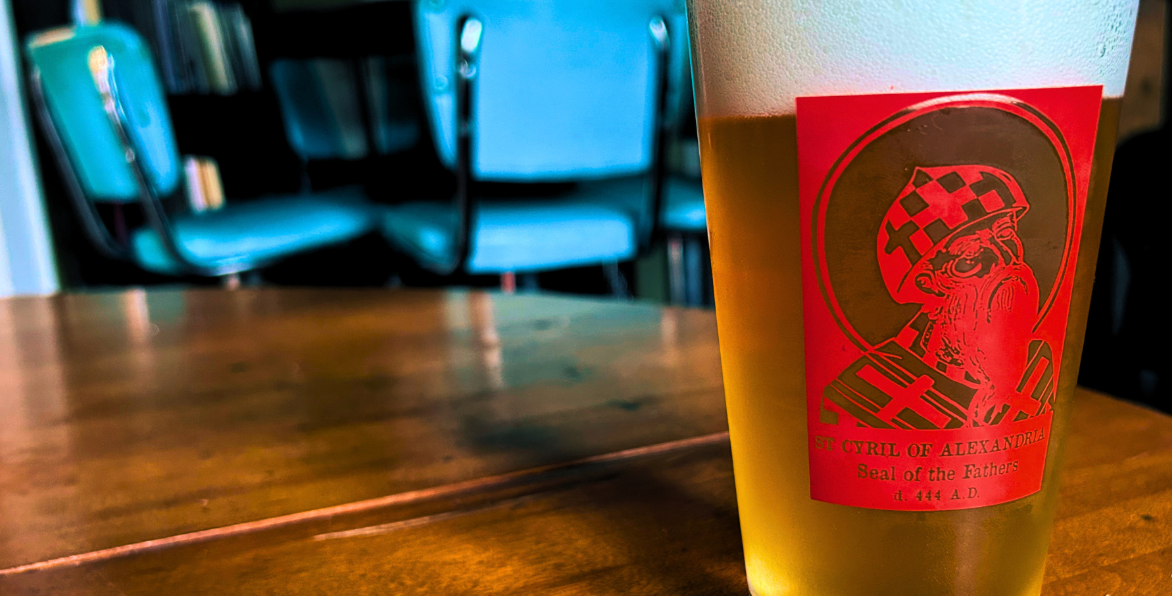
Let a man walk ten miles steadily on a hot summer’s day along a dusty English road, and he will soon discover why beer was invented. The fact that beer has a very slight stimulating quality will be quite among the smallest reasons that induce him to ask for it. In short, he will not be in the least desiring alcohol; he will be desiring beer. But, of course, the question cannot be settled in such a simple way. The real difficulty which confronts everybody, and which especially confronts doctors, is that the extraordinary position of man in the physical universe makes it practically impossible to treat him in either one direction or the other in a purely physical way. Man is an exception, whatever else he is. If he is not the image of God, then he is a disease of the dust. If it is not true that a divine being fell, then we can only say that one of the animals went entirely off its head. In neither case can we really argue very much from the body of man simply considered as the body of an innocent and healthy animal. His body has got too much mixed up with his soul, as we see in the supreme instance of sex. It may be worth while uttering the warning to wealthy philanthropists and idealists that this argument from the animal should not be thoughtlessly used, even against the atrocious evils of excess; it is an argument that proves too little or too much. Doubtless, it is unnatural to be drunk. But then in a real sense it is unnatural to be human. Doubtless, the intemperate workman wastes his tissues in drinking; but no one knows how much the sober workman wastes his tissues by working. No one knows how much the wealthy philanthropist wastes his tissues by talking; or, in much rarer conditions, by thinking. All the human things are more dangerous than anything that affects the beast—sex, poetry, property, religion. The real case against drunkenness is not that it calls up the beast, but that it calls up the Devil. It does not call up the beast, and if it did it would not matter much as a rule; the beast is a harmless and rather amiable creature, as anybody can see by watching cattle. There is nothing intoxicating or even particularly lively about beasts. We hear of mad bulls, but they are not mad through delirium tremens; nor does their dislike of scarlet originate in a resolution not to look upon the wine or upon anything else when it is red. We hear of mad dogs, and we even hear that they dislike water; but this dislike is not due to the same cause which creates a similar prejudice in so many human beings. Man is always something worse or something better than an animal; and a mere argument from animal perfection never touches him at all. Thus, in sex no animal is either chivalrous or obscene. And thus no animal ever invented anything so bad as drunkenness—or so good as drink.
The pronouncement of these particular doctors is very clear and uncompromising; in the modern atmosphere, indeed, it even deserves some credit for moral courage. The majority of modern people, of course, will probably agree with it in so far as it declares that alcoholic drinks are often of supreme value in emergencies of illness; but many people, I fear, will open their eyes at the emphatic terms in which they describe such drink as considered as a beverage; but they are not content with declaring that the drink is in moderation harmless: they distinctly declare that it is in moderation beneficial. But I fancy that, in saying this, the doctors had in mind a truth that runs somewhat counter to the common opinion. I fancy that it is the experience of most doctors that giving any alcohol for illness (though often necessary) is about the most morally dangerous way of giving it. Instead of giving it to a healthy person who has many other forms of life, you are giving it to a desperate person, to whom it is the only form of life. The invalid can hardly be blamed if by some accident of his erratic and overwrought condition he comes to remember the thing as the very water of vitality and to use it as such. For in so far as drinking is really a sin it is not because drinking is wild, but because drinking is tame; not in so far as it is anarchy, but in so far as it is slavery. Probably the worst way to drink is to drink medicinally. Certainly the safest way to drink is to drink carelessly; that is, without caring much for anything, and especially not caring for the drink.
The doctor, of course, ought to be able to do a great deal in the way of restraining those individual cases where there is plainly an evil thirst; and beyond that the only hope would seem to be in some increase, or, rather, some concentration of ordinary public opinion on the subject. I have always held consistently my own modest theory on the subject. I believe that if by some method the local public-house could be as definite and isolated a place as the local post-office or the local railway station, if all types of people passed through it for all types of refreshment, you would have the same safeguard against a man behaving in a disgusting way in a tavern that you have at present against his behaving in a disgusting way in a post-office: simply the presence of his ordinary sensible neighbors. In such a place the kind of lunatic who wants to drink an unlimited number of whiskies would be treated with the same severity with which the Post Office authorities would treat an amiable lunatic who had an appetite for licking an unlimited number of stamps. It is a small matter whether in either case a technical refusal would be officially employed. It is an essential matter that in both cases the authorities could rapidly communicate with the friends en famille of the mentally afflicted person. At least, the postmistress would not dangle a strip of tempting sixpenny stamps before the enthusiast’s eyes as he was being dragged away with his tongue out.
*Originally published in The Illlustrated London News, 20 April, 1907.
Share this Post on Your Preferred Platform