100 Miles for 100 Members

by Erin Doom


Feast of St Gregory the Wonderworker & Bishop of Neo-Caesarea

Anno Domini 2022, November 17
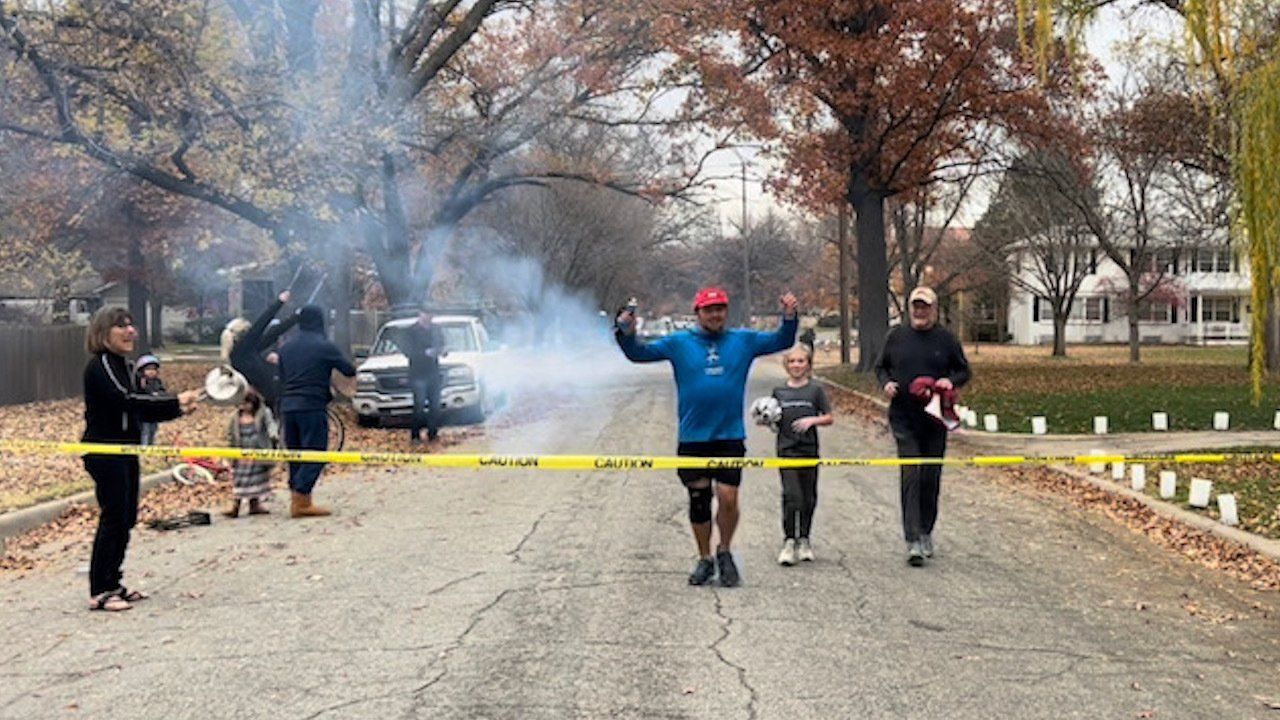
From Sep 2021 thru Sep 2022, I ran four 50ks, one 100k, one pseudo-backyard ultra of 88 miles (pseudo because I ran 3.67 instead of official 4.167 mile laps), and attempted one 50-miler and two 100-milers. With my second marathon mixed in, I ran over 500 miles in races. Not bad for my first year of ultra running (or maybe really bad and/or totally insane?).


At my first 100-mile attempt in February (Rocky Raccoon), I bowed out at mile 74 with hypothermia (I climbed 5000 ft in this TX race, compared to 3100 ft in my neighborhood 88-miler). At the 50-mile attempt in July (Pikes Peak Ultra), I missed cutoff at mile 22 but they allowed me to finish a long 50k (I ended up running 40.1 miles and climbed 8,900 feet). At the second 100-mile attempt in September (Run Rabbit Run), I was forced out by time at mile 77 (this one I climbed 15,000 feet…and destroyed my left knee which forced a six-week break from running). That means I’ve got two big fat DNFs (Did Not Finish) on my official running record.


As much as I hate to lose, the improvements I experienced over the course of one year of ultrarunning have been dramatic. Thus, instead of being dragged down by failures, those huge gains have enabled me to keep a positive attitude by viewing those DNFs as mere stepping stones.


I can’t wait for redemption at Rocky Raccoon and Run Rabbit Run. I look forward to running other more iconic races such as Leadville 100, Western States Endurance Run 100, and UTMB 100. I know it sounds crazy, but I also look forward to even longer runs: Cowboy 200, Bigfoot 200, Tahoe 200, Moab 240, and Cocodona 250 (and yes, those races are 200, 240, and 250 miles!). Come June I’ll be doing a practice run for these longer runs at a 72-hour race here in Kansas called The Sticks (organized by great folks at Ultraverse Supplements, whose Proxima C Endurance Fuel I’ve been using; they also organized the first 100k I ran). In the meantime, I still need to finish 100 miles, which is precisely what I’m going to do on November 25-26.


Last November I ran 88 miles to raise funds for Eighth Day Institute on Giving Tuesday. Until then I had only completed two marathons, two 50ks, and one 100k (barely!). If friends had not spontaneously appeared as a pop-up crew to take care of me at the aid station in my front yard—led by Jake Ramstack, they fed me, clothed me for the cold, and each lap literally lifted me out of my chair and pushed me back onto the road to run more—and if others had not arrived to run a lap or two (or six in the case of Oscar Repreza…that’s basically a marathon!), I am 100% confident I would not have been able to finish those 88 miles.


It's that time of year again and I intend to make this a tradition. Since I failed to reach the 100 mile mark twice this year, and since Eighth Day Institute’s fall campaign goal is to recruit 100 new members, I’m going to run 100 miles for 100 members in what I'm dubbing "Dr. Doom's College Hill Pseudo-Backyard Ultra."


I’ll start running at noon next Friday (the day after Thanksgiving, on November 25, 2022). Last year I ran 3.67 mile laps; this year I’m running 3.92 mile laps; next year I’ll run the official backyard ultra 4.167 mile laps. If I can stay on schedule like I did last year (1 lap every hour), I’ll finish 25.5 hours later around 1:30 pm on Saturday, November 26. More important than staying on schedule, however, is finishing my first 100-miler and recruiting 100 new Eighth Day members (we've already recruited 19 of them!).


I’d love for you to be a part of this crazy—but in my humble opinion, also wonderful—endeavor. Here are at least five ways you can participate: 1) pace me, i.e., run a lap or two with me; 2) crew me, i.e., take care of me between laps; 3) cheer me on (last year, this included fireworks and lots of folks at my front yard aid station); 4) support my effort by becoming an Eighth Day Member here; and/or 5) spread the word by either sharing this page or the same post on our Facebook page.


For those of you who can join me at any point during the 25.5 hours or more next Friday and Saturday, in addition to the aid tent and supplies for me, I’ll have in my front yard a table and chairs, a keg of beer (and wine or any other drink of choice, if requested), and an outdoor portable forced air heater, all for visitors to experience Eighth Day “conversations you can’t have anywhere else.”


If you have any questions or don’t know my home address, email me or text me at 316.573.8413.

Share this Post on Your Preferred Platform

By Luke Taylor Gilstrap July 31, 2026
"What is it that has ordered the things of heaven and those of earth, the things which move through the air and those which move in the water; nay, rather the things which proceeded them: heaven and earth and the natures of fire and water? What is it that combined and arranged them...set them into motion and put them on their unceasing and unhindered course?..But who is the architect of these things? Or did not he who made them also bring them into being? We shall certainly not attribute such power to spontaneity." On the Orthodox Faith, Chapter 3 This comes after St. John of Damascus sets out to delineate between the created and the uncreated, a fact which, while at the core of existence, seems for him to be, for this very reason, the simplest to believe. Everything but God is created and, thus, susceptible to change. This means people, but this also means demons, angels, the rest of the created order across the entire cosmos. Everything is vulnerable to unrest. Except for God. If you have ever tried to explain the Holy Trinity to a child for the first time, maybe you have felt as I have the weightier, inexpressible side of God's unchangeability: how do I possibly communicate this essential fact to the person in front of me? (This is usually when my faint stutter starts to pop up again.) I like that here, like St. Patrick reaching for a three-leaf clover, St. John brings us back to earth to better understand the cosmos. Fire and water are no less mysteries than heaven and earth. And yet here we are, cooking and washing, eating and drinking, filled and sustained on what we can neither fully explain nor claim to have created. Only God is unchanging. Vice versa, God is the only constant we need. Maybe the rest is better left unsaid. LUKE TAYLOR GILSTRAP is Vice President of the Board of Directors for Eighth Day Institute. His poems have appeared in Spiritus, Ekstasis (Christianity Today), and Relief Journal, among others. He lives happily in Wichita, Kansas with his wife and three sons.
By Luke Taylor Gilstrap July 24, 2026
"Now, one who would speak or hear about God should know beyond any doubt that in what concerns theology and the Incarnation not all things are inexpressible and not all are capable of expression, and neither are all things unknowable nor are they all knowable. That which can be known is one thing, whereas that which can be said is another, just as it is one thing to speak and another to know. Furthermore, many of those things about God which are not clearly perceived cannot be fittingly described, so that we are obliged to express in human terms things which transcend the human order. Thus, for example, in speaking about God we attribute to Him sleep, anger, indifference, hands and feet, and the like." On the Orthodox Faith, Chapter 2 When I was studying Fiction in graduate school, one of the first methods I learned to really situate the reader in the story you were about to tell them was disorientation; if you wanted to ground them in one story, first you had pull the rug out from under their feet. So it's fitting that in the beginning of St. John Damascene's On the Orthodox Faith, before rebuilding our foundation, he first puts us squarely in limbo, seesawing back and forth between certainty and uncertainty. To paraphrase, there is no doubt (certainty) that about God some things can be expressed...but not all things (uncertainty). Some things about God are truly knowable (certainty), but some are unknowable (uncertainty). Oh, and while we're speaking about God (certainty), let's admit there's a gap, too, between what we say and what we know (uncertainty). My favorite line in this spiraling excerpt, "...it is one thing to speak, and another to know," takes me back to the final lines in Wendell Berry's poem, "How to Be a Poet," which he wrote primarily as a reminder to himself: Accept what comes from silence. Make the best you can of it. Of the little words that come out of the silence, like prayers prayed back to the one who prays, make a poem that does not disturb the silence from which it came. Wherever your preferences fall on the cataphatic or apophatic spectrum of theology (whether you lean more toward what we can say about God or what we cannot), Berry's poem, I think, would nod along with St. John: before we say too much, let our words be preserved by the silence from which they came. I'm thinking of the silence, that filling, restorative quiet I feel when I step into a cathedral or in some of my favorite moments with my kids in the early hours. Even before praying, can we hear the One already praying in us? ​​​​​​​Let's start there. LUKE TAYLOR GILSTRAP is Vice President of the Board of Directors for Eighth Day Institute. His poems have appeared in Spiritus, Ekstasis (Christianity Today), and Relief Journal, among others. He lives happily in Wichita, Kansas with his wife and three sons.
By Mark C. Watney July 20, 2026
Late-Night Bookstores and Spiritual Reading
By Sarah Orner July 20, 2026
On St. Benedict and the Making of Vows
By Luke Taylor Gilstrap July 20, 2026
The Pursuit of Truth in the Age of AI
By Michael Simmon July 20, 2026
On the Theology of Raising Chickens
By Luke Taylor Gilstrap July 20, 2026
G.K. Chesterton and Raising Small Children
By Fr. Mark Lovett June 9, 2026
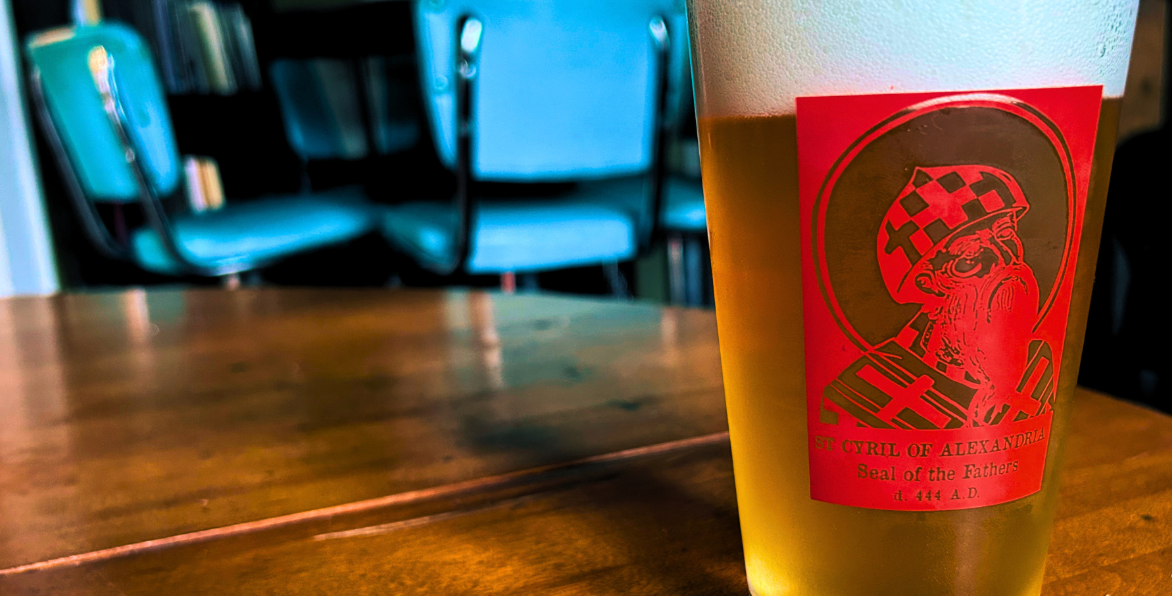
"Seal of the Fathers"
By Luke Taylor Gilstrap June 9, 2026
In Memory of Warren Farha, 1955-2026
By Jeremy Wagner May 15, 2026
An Ode to St. Brendan the Voyager
More Posts